top of page
Aviation Art & Photography
My fascination with aviation began in childhood, when my father gave me photographs of aircraft, particularly Lancasters and Spitfires. Instead of buying balsa-wood aircraft kits, we began building our own from drawings, scaling the plans and constructing the airframes ourselves. Before long my bedroom ceiling was full of them — and I had developed a lifelong fascination with aircraft drawings, blueprints and aviation history.
That fascination has stayed with me throughout my life and continues in my aviation artwork today. My work combines original illustration, photography and digital techniques, with subjects ranging from pioneering aircraft and the golden age of flight to the iconic military aircraft of the Second World War.
Project type
Aviation Art & Illustration

01
Aviation Art & Photography

01
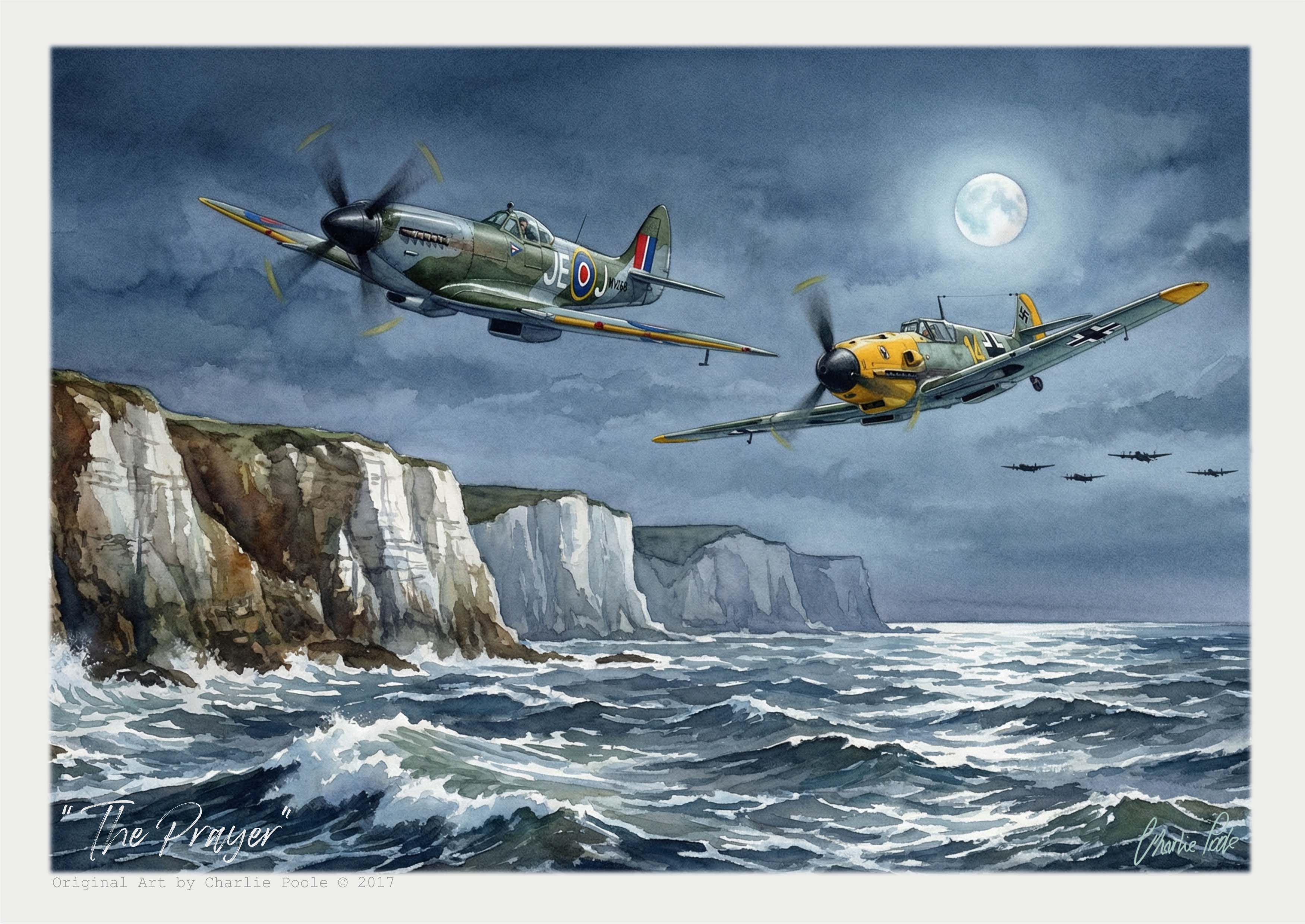
Battle over the White Cliffs – Spitfire and Messerschmitt
This watercolour was created from three of my original photographs. I photographed the Spitfire and Messerschmitt at an air display at Little Gransden, while the White Cliffs of Dover came from a separate photograph taken during a pleasure-boat trip.
I first sketched each element onto an A2 sheet of Bockingford watercolour paper, then developed the painting by hand using the same gradual process shown in my Mini Cooper project. Nearly 200 hours of work went into completing the watercolour, followed by final adjustments in Photoshop to perfect the finished image.
I first sketched each element onto an A2 sheet of Bockingford watercolour paper, then developed the painting by hand using the same gradual process shown in my Mini Cooper project. Nearly 200 hours of work went into completing the watercolour, followed by final adjustments in Photoshop to perfect the finished image.

02
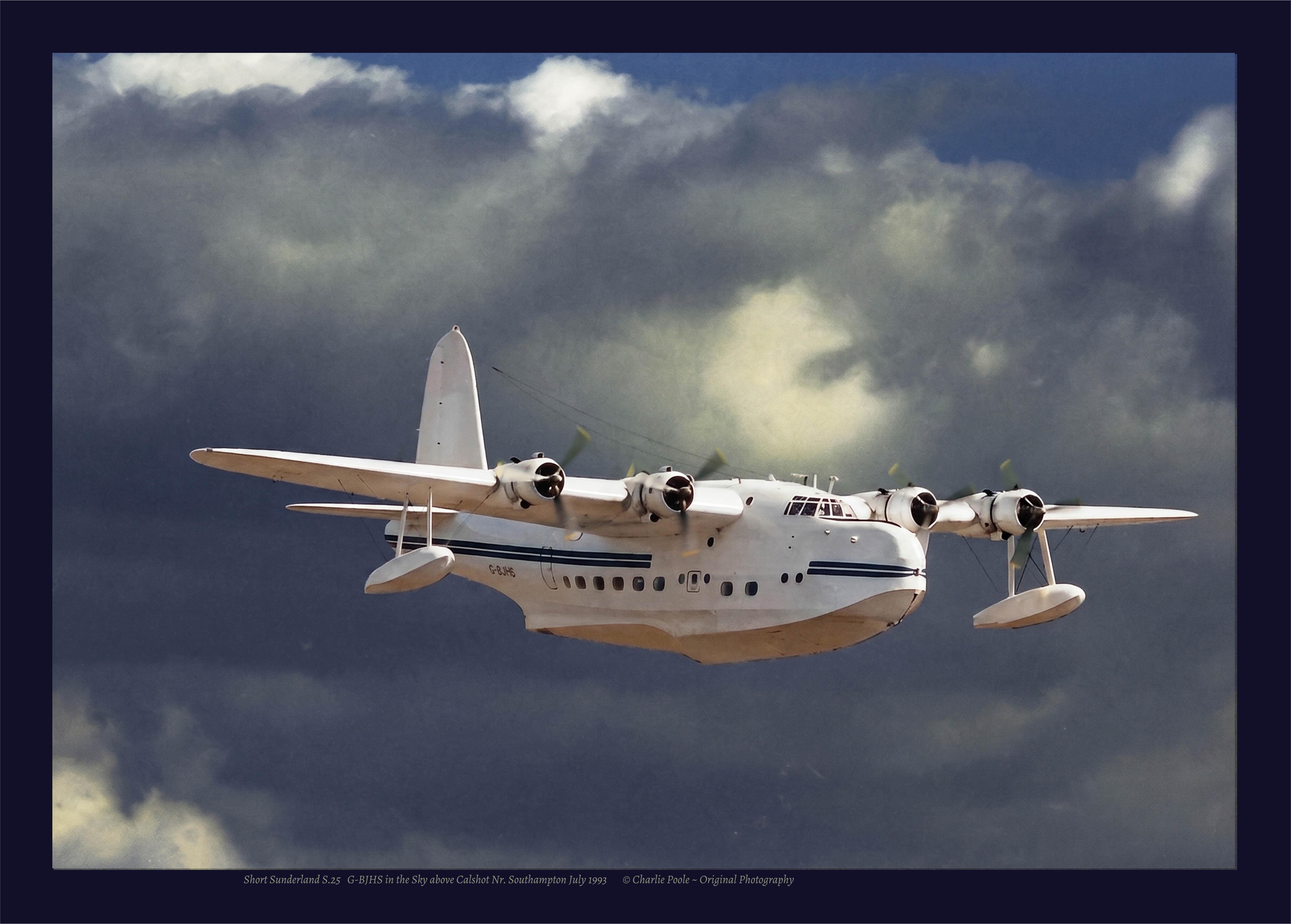
The Last Flight of G-BJHS – Short Sunderland S.25 Mk V
My father, Alfie, photographed Short Sunderland G-BJHS at Calshot, near Southampton, on 20 July 1993. He travelled there with a friend who had flown Sunderlands during the Second World War. The flying boat was leaving for an aeronautical museum in the United States, where it was to be restored to its wartime specification, including the reinstatement of its gun turrets.
Developed and built by Short Brothers for the Royal Air Force, the Sunderland was a British maritime patrol flying boat named after the city in North East England. It played a pivotal role with RAF Coastal Command during the Battle of the Atlantic, helping defend Allied shipping against German U-boats.
The Sunderland remained in RAF service until 1959 and also served during the Berlin Airlift and the Korean War. Civilian versions were operated after the war by BOAC.

03
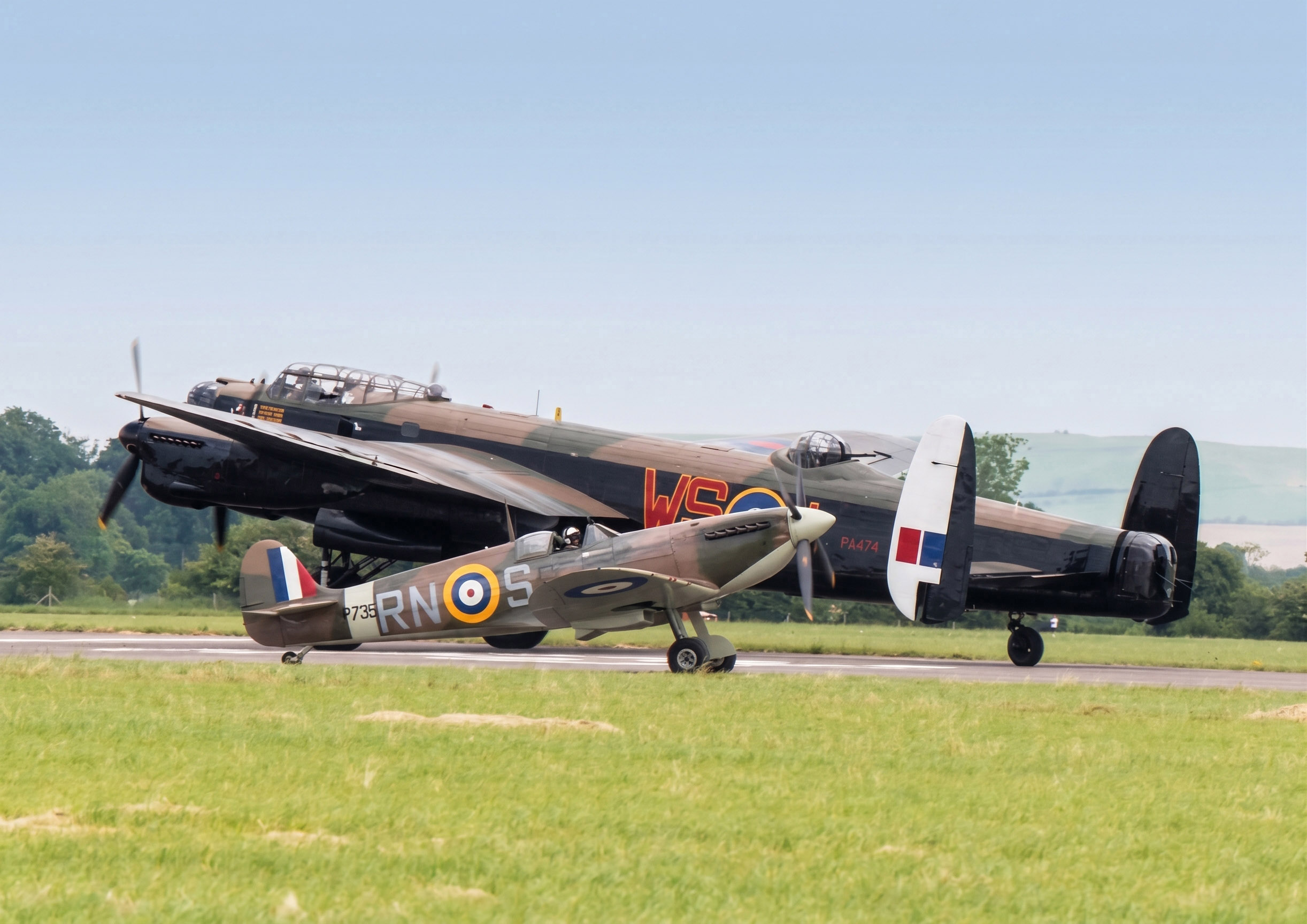
Spitfire P7350 and Lancaster PA474 – RAF Coningsby, 1994
I photographed these two remarkable survivors together at RAF Coningsby in 1994.
In the foreground is Supermarine Spitfire Mk IIa P7350, the oldest airworthy Spitfire in the world and the only surviving airworthy example to have fought in the Battle of Britain. When photographed, it carried the historic “RN-S” codes of No. 72 Squadron.
Behind it is Avro Lancaster B.I PA474, one of only two airworthy Lancasters remaining in the world. At the time, its starboard side carried the “WS-J” markings of No. 9 Squadron.

04
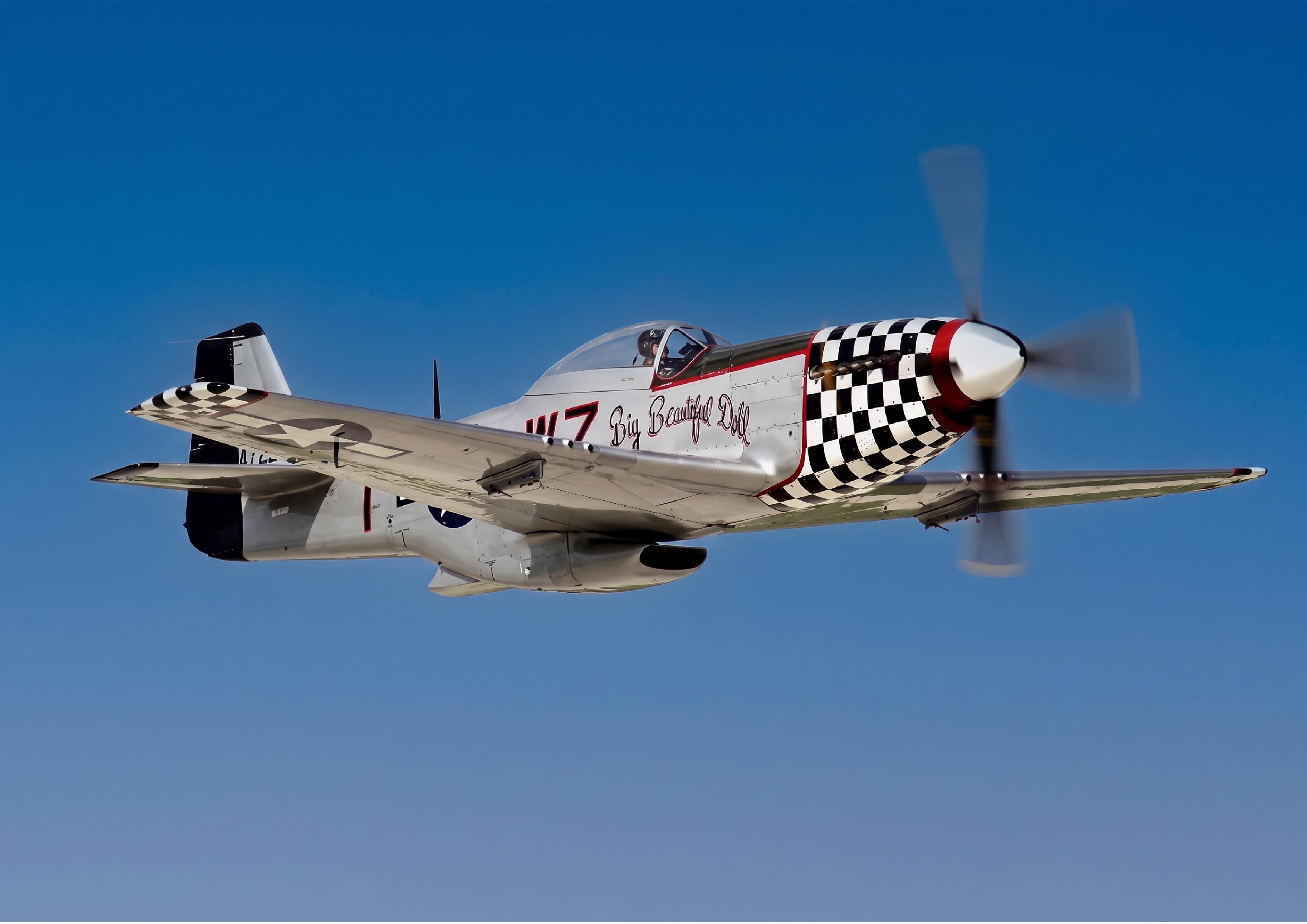
P-51D Mustang “Big Beautiful Doll” – Little Gransden, 2019
I photographed this North American P-51D Mustang on a blisteringly hot day at the Little Gransden Air and Car Show in 2019.
The restored warbird wears the distinctive checkerboard nose and “Big Beautiful Doll” markings associated with Colonel John D. Landers, an American fighter ace who served in both the Pacific and European theatres during the Second World War.
The P-51D became one of the war’s most celebrated long-range fighters and bomber escorts. Its Packard-built version of the Rolls-Royce Merlin V-12 engine gave the Mustang the high-altitude performance and range needed to accompany Allied bombers deep into occupied Europe.

05
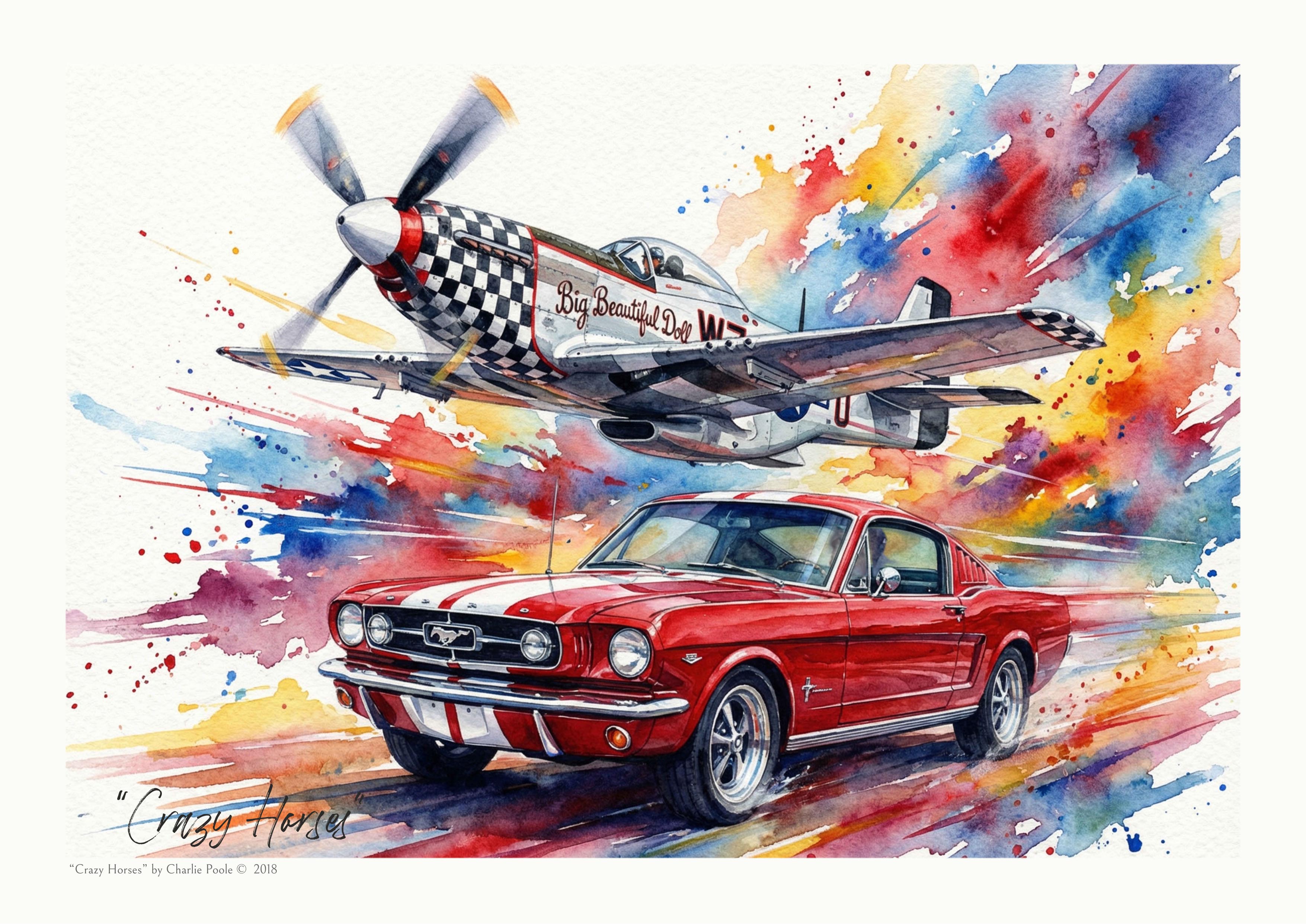
Crazy Horses – Two American Mustangs
“Crazy Horses” brings together two very different American legends bearing the Mustang name.
The North American P-51D Mustang was photographed by me at Little Gransden, while the 1965 Ford Mustang GT350 Fastback was photographed in a car park at Hampton Court during the Concours of Elegance in September 2018.
I developed both original photographs using the process demonstrated in my 'From Photograph to Watercolour Artwork & Digital Art project'. The separate elements were then brought together in Corel Painter using three layers: the painted background, the aircraft and car, and a final flourish of colour. The precise Painter technique remains my trade secret.

06
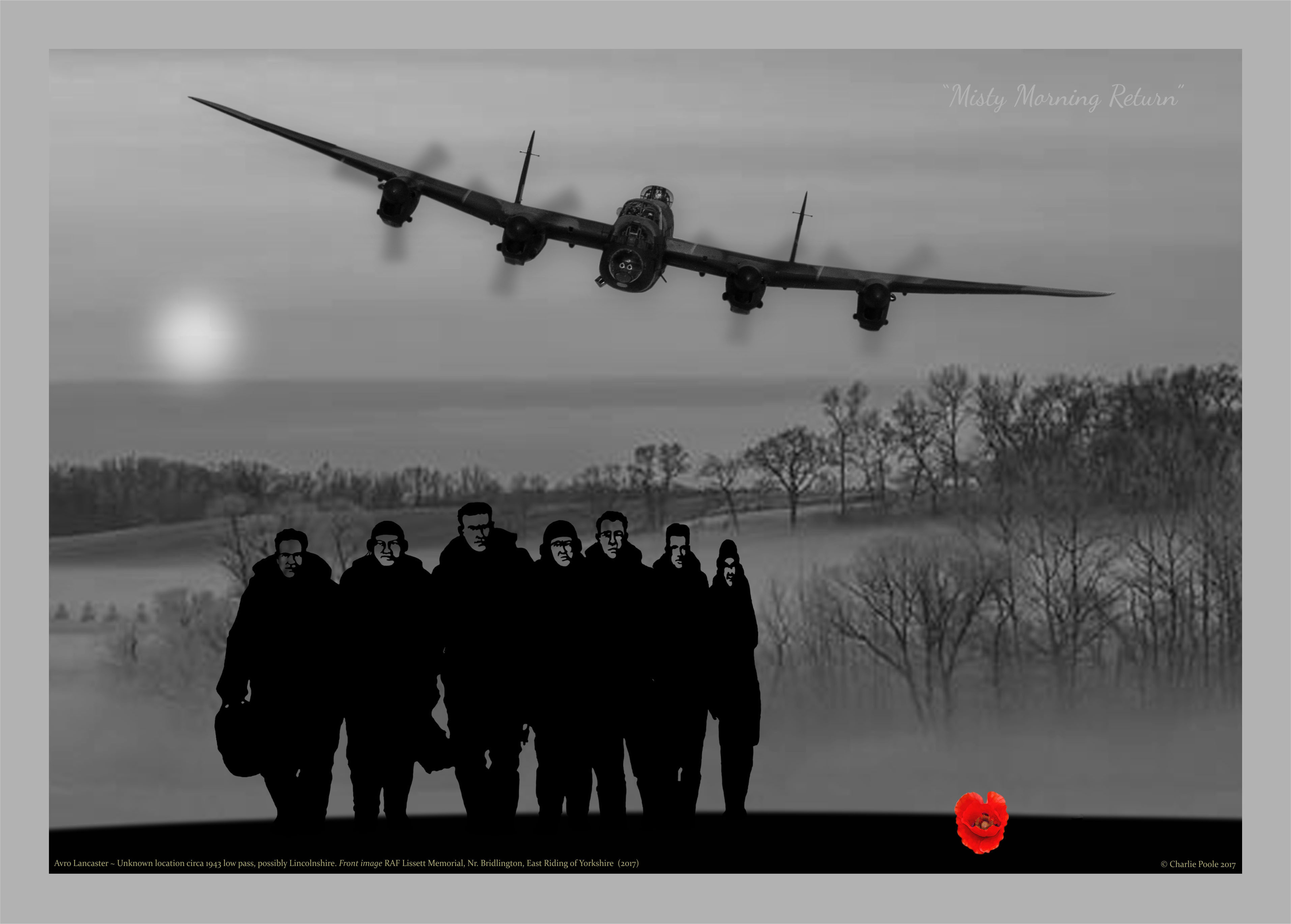
Misty Morning Return – Avro Lancaster and Lissett Memorial
“Misty Morning Return” is an atmospheric composition created by combining two photographs in Photoshop.
The Avro Lancaster was photographed by my father, Alfie, sometime between 1943 and 1944. Its precise location is unknown, although it was probably taken in Lincolnshire or East Yorkshire. The foreground comes from my more recent photograph of the memorial to No. 158 Squadron at Lissett, beside the former RAF airfield on Gransmoor Road.
Designed by Peter W. Naylor, the steel memorial represents the seven members of a typical Halifax bomber crew and commemorates the 851 airmen who failed to return from operations flown from RAF Lissett. Naylor received the 2010 Marsh Award for Excellence in Public Sculpture for the work.
I merged the two photographs to create my own quiet tribute to the courage and sacrifice of those airmen.

07
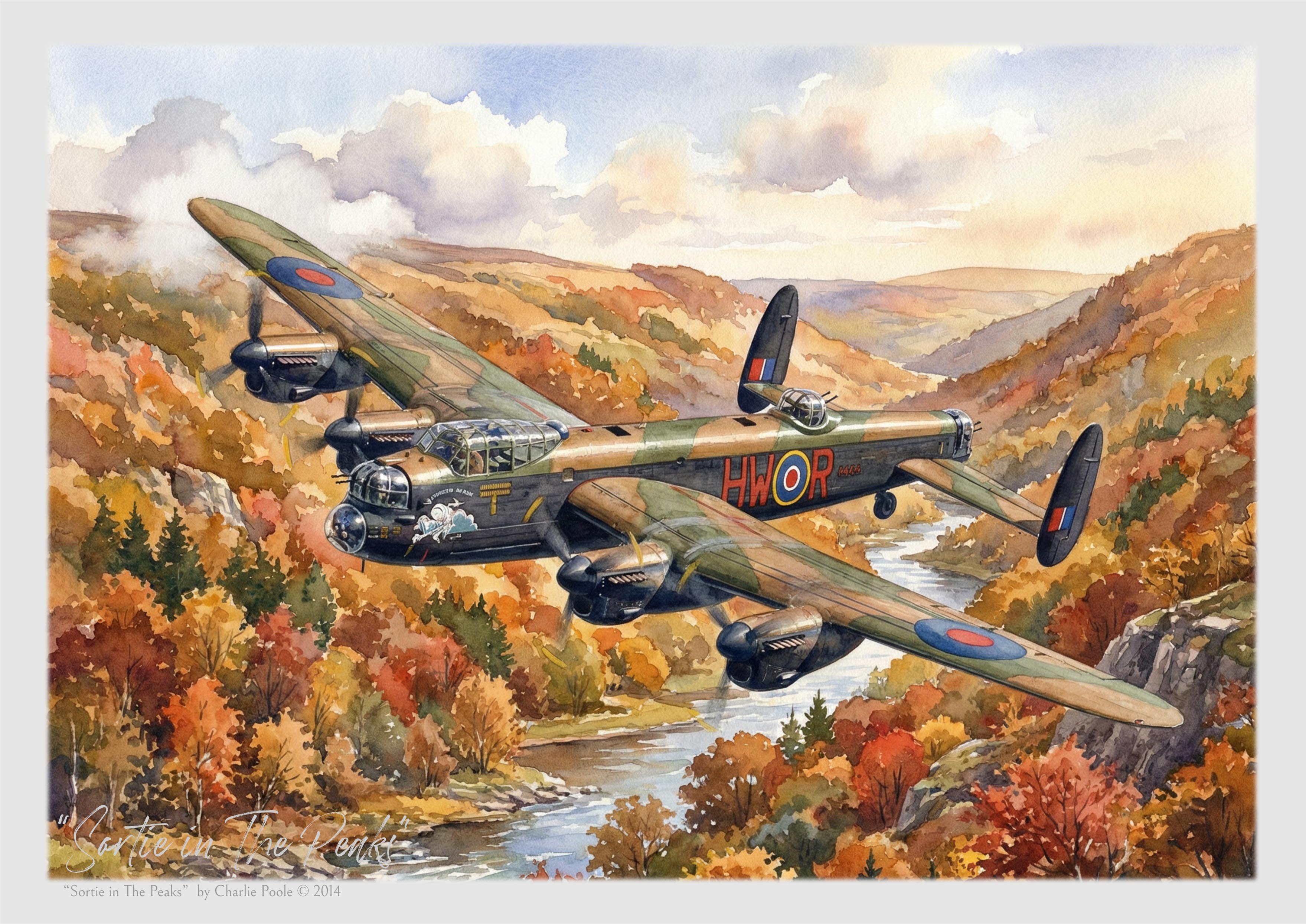
Sortie in the Peak – Lancaster “Phantom of the Ruhr”
“Sortie in the Peak” began with my photograph of Battle of Britain Memorial Flight Lancaster PA474 at an airshow—quite possibly Duxford, although unfortunately I did not record the location or date.
At the time, PA474 carried the markings of Avro Lancaster B Mk.I EE139, “Phantom of the Ruhr,” on its port side. The original aircraft served with No. 100 Squadron from RAF Waltham, near Grimsby, carrying the squadron code HW-R. It became one of Bomber Command’s remarkable “centenarians,” surviving 121 operational sorties.
I developed the aircraft from my photograph into an A2 watercolour using the same gradual process demonstrated in my Mini Cooper project. Because the Phantom nose artwork was extremely difficult to reproduce clearly at that scale, I painted it separately as a larger watercolour, scanned it, and carefully overlaid it onto the completed painting in Photoshop.
The Peak District background is fictional, created by merging two separate views of Derbyshire’s Derwent Valley. The resulting scene never existed as a photograph—but every element originated in photography, drawing and hand-painted watercolour.

08
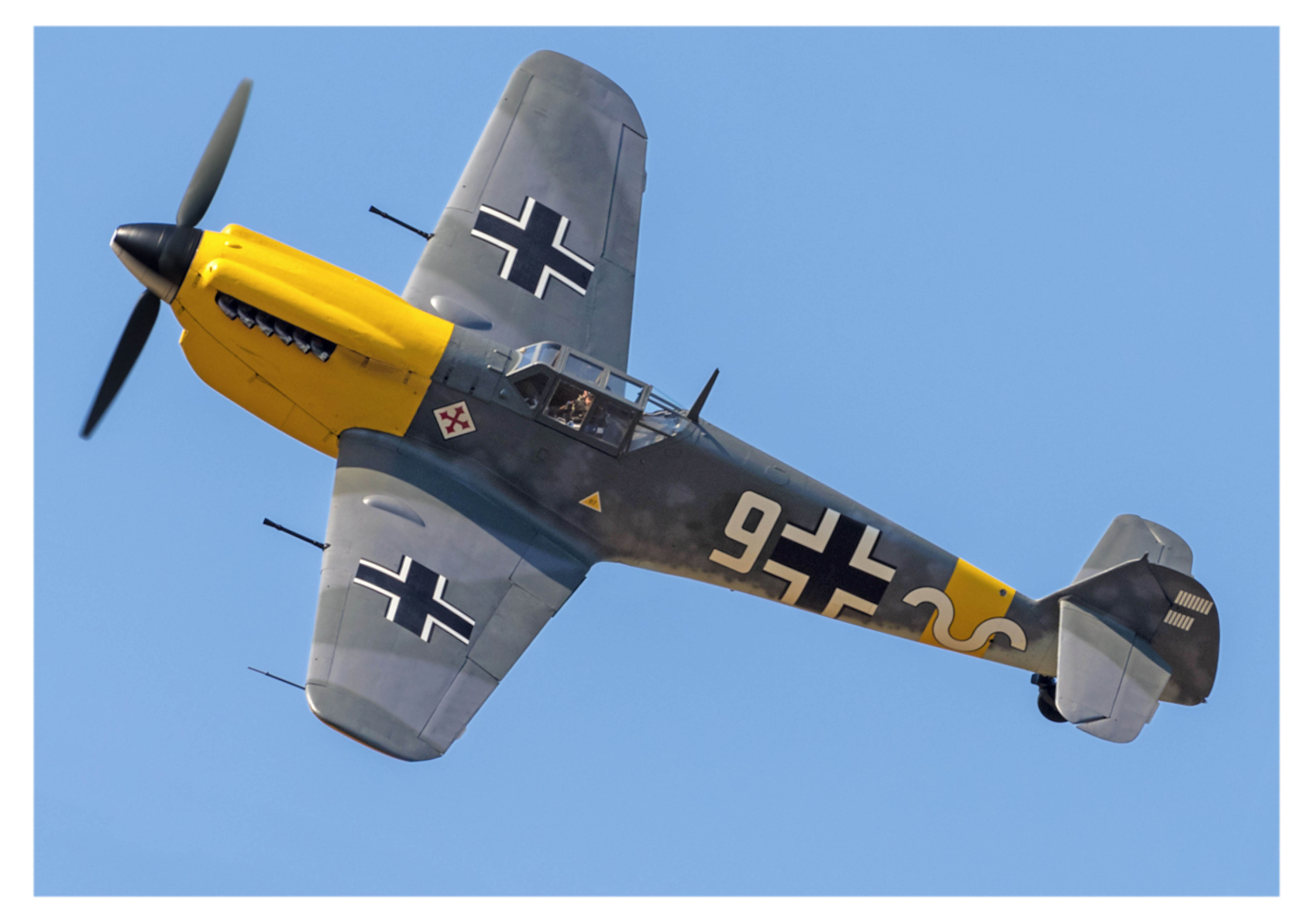
Hispano Buchón “White 9” – Little Gransden, 2019
I took this photograph at the Little Gransden Air and Car Show in 2019, on another blisteringly hot day. Unlike many of the images in this collection, it has not been altered or combined with anything else—it is a straightforward photograph captured during the display.
The aircraft is Hispano HA-1112-M1L Buchón G-AWHH, a Spanish-built development of the Messerschmitt Bf 109. Built in Seville in 1958, it served with the Spanish Air Force and is powered by a Rolls-Royce Merlin 500/45 engine rather than the Daimler-Benz engine fitted to German-built Bf 109s.
It wears the Luftwaffe “White 9” markings associated with fighter ace Edmund Roßmann of Jagdgeschwader 52. The aircraft also appeared in the 1968 film Battle of Britain.

09
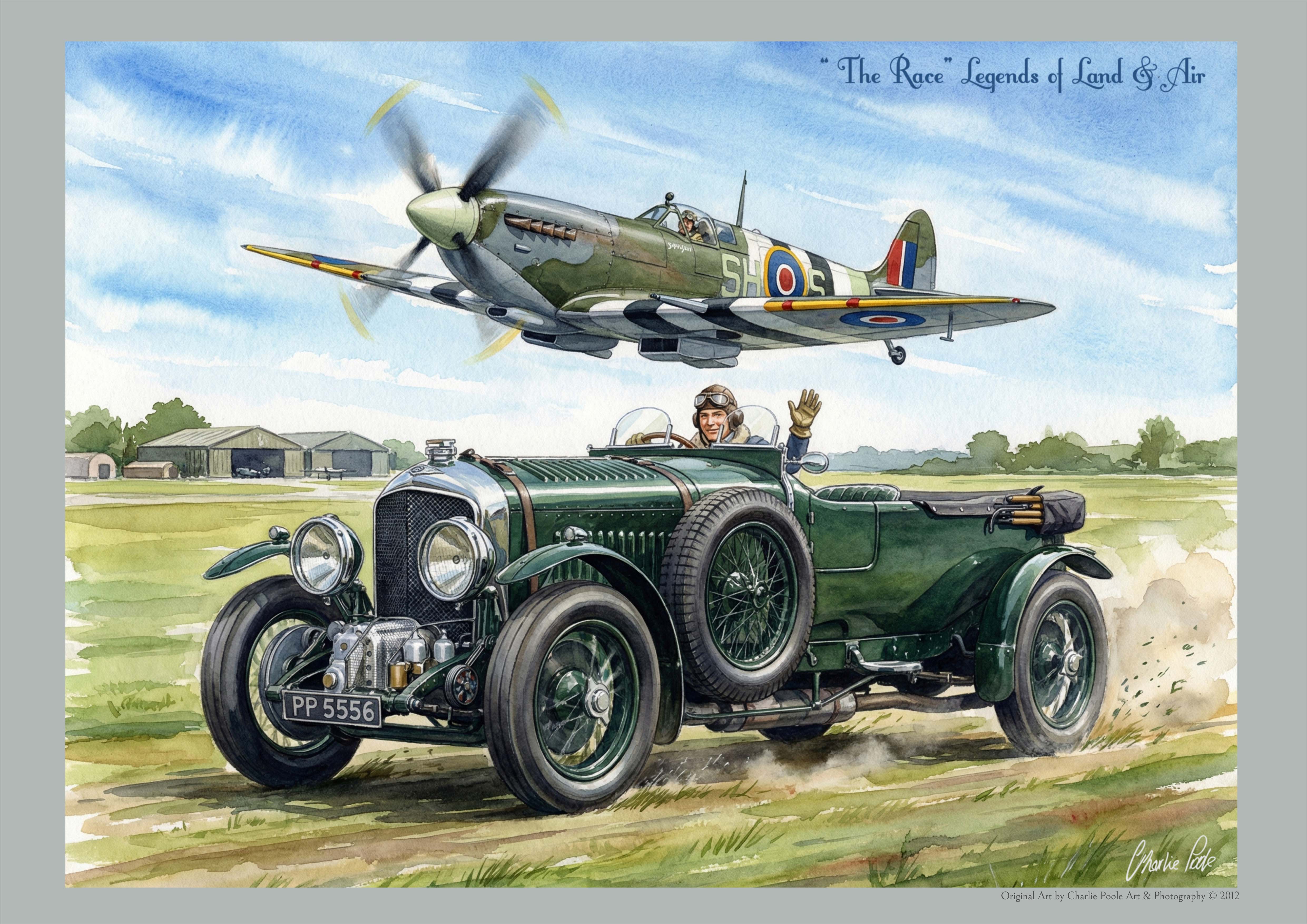
The Race – Legends of Land and Air
“The Race – Legends of Land and Air” was something of a painter’s nightmare, bringing a Supermarine Spitfire and a 4½-litre Bentley together in a completely fictional airfield scene.
The Spitfire was developed from one of my own photographs, most probably taken at Duxford. Unfortunately, I can no longer find either the original photograph or my early mock-ups. Its “SH-S” identity remains a mystery: SH was the genuine wartime code of No. 64 Squadron RAF, which operated Spitfires, but I have been unable to identify a documented aircraft carrying the complete code SH-S.
I photographed the Bentley at the Goodwood Festival of Speed in 2012. Its number plate is deliberately fictional. I developed both subjects into watercolour using my usual photograph-to-painting process, then created and added the imaginary airfield setting afterwards.
The encounter never happened, but it brings together two extraordinary examples of British engineering in a race that exists only in my imagination.

10
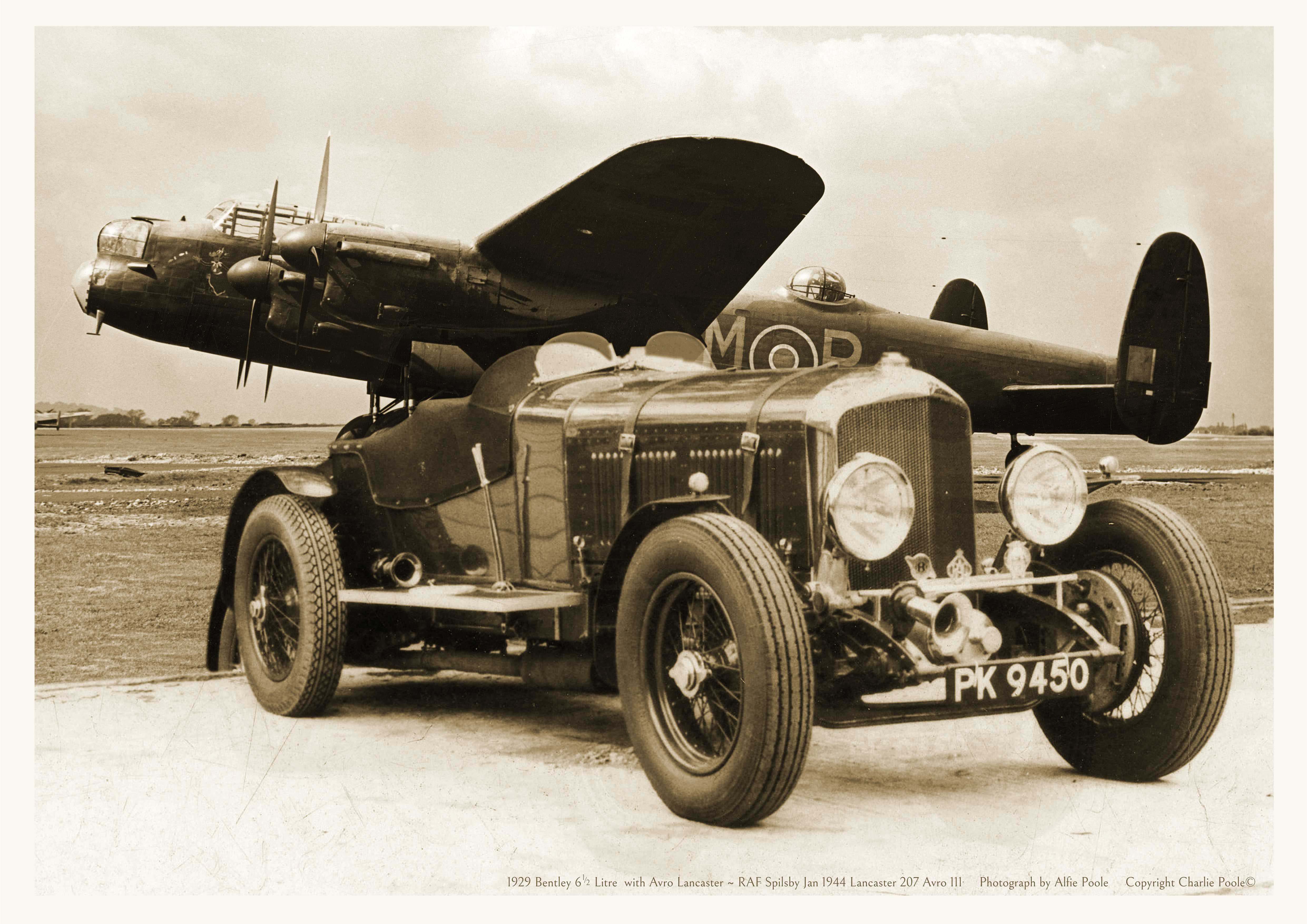
RAF Spilsby, January 1944 – Lancaster ED413 and Bentley PK 9450
My father, Alfie, took this photograph at RAF Spilsby in Lincolnshire during January 1944. His faint handwritten note on the reverse reads: “RAF Spilsby – Jan 1944 – Lancaster – 207 – Avro III.”
Research confirmed the aircraft as Avro Lancaster B Mk III ED413, carrying the code EM-P of No. 207 Squadron RAF. ED413 transferred to 207 Squadron on 20 January 1944, which dates Dad’s photograph to the remarkably narrow period between 20 and 31 January 1944.
Parked beside it is Bentley 6½ Litre Vanden Plas Tourer PK 9450, built in 1929 with chassis LB2342 and engine LB2344. The Bentley belonged to a friend of Dad’s, who allowed him to borrow it on several occasions—including a journey to Bridlington with my mother around Valentine’s Day 1944.
Dad’s pencil annotation, the Lancaster’s visible serial and squadron code, the Bentley registration and surviving historical records all independently support the identification.

11
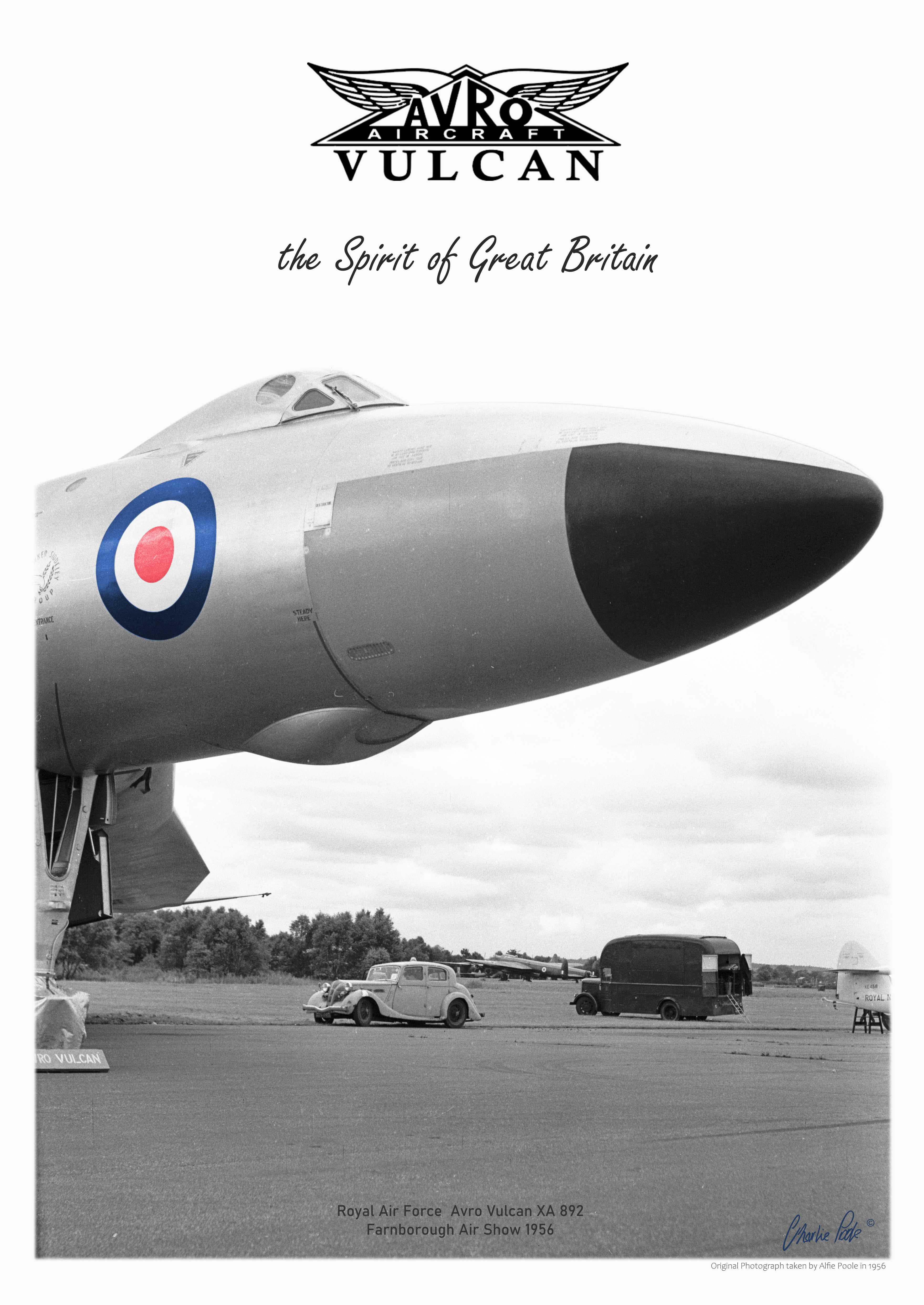
The Spirit of Great Britain – Vulcan XA892 at Farnborough, 1956
My father, Alfie, took this remarkable photograph at the Farnborough Air Show on 4 September 1956 using his Leica IIIb.
Dominating the sky is Royal Air Force Avro Vulcan B.1 XA892, the fourth production Vulcan. It first flew in November 1955 with Bristol Olympus 101 engines and wears the silver finish characteristic of the early B.1 aircraft. XA892 was later used for ground instruction at the RAF School of Technical Training at Halton before being scrapped in July 1971. An Avro Lancaster can also be seen at the far right of the photograph.
In the foreground is our family’s 1938 Triumph Dolomite 1.5-litre Sports Saloon, registration GUV 997. My uncle can just be seen in the front passenger seat, while my mother and I are sitting together on the back seat.
I scanned Alfie’s original photograph and carefully enhanced it where necessary, preserving an extraordinary meeting of aviation history, family history and British motoring.

12
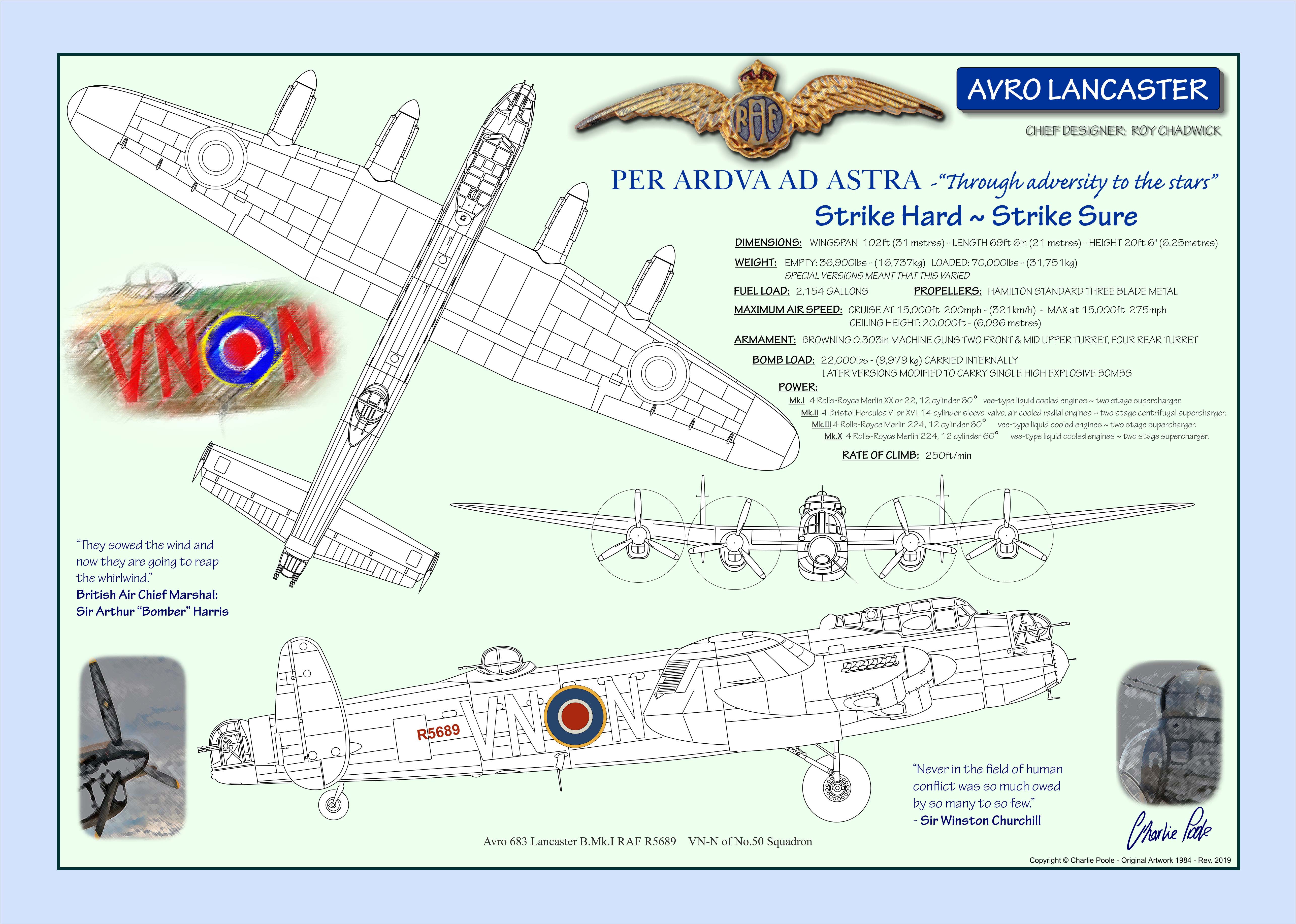
Avro Lancaster R5689 VN-N – Original Scale Drawing
This detailed scale drawing depicts Avro Lancaster B Mk I R5689, carrying the code VN-N of No. 50 Squadron RAF.
Its origins go back to my childhood, when my father supplied me with original aircraft photographs and technical reference material, some dating from 1938. I began with pencil drawings and schoolboy doodles before recreating the aircraft more accurately on my first drawing board. These plans allowed me to build scale models from balsa wood and tissue paper—although, sadly, I never managed to produce one that flew successfully.
Many years later, I scanned my original drawing and carefully redrew every line digitally in Photoshop, producing the clean and consistent linework seen here. I added technical specifications, historical facts, period quotations and a pastel study of the Lancaster’s fuselage.
This is not a scanned or copied RAF blueprint. Every line developed from my own drawings, research and the reference material preserved by my father.

13
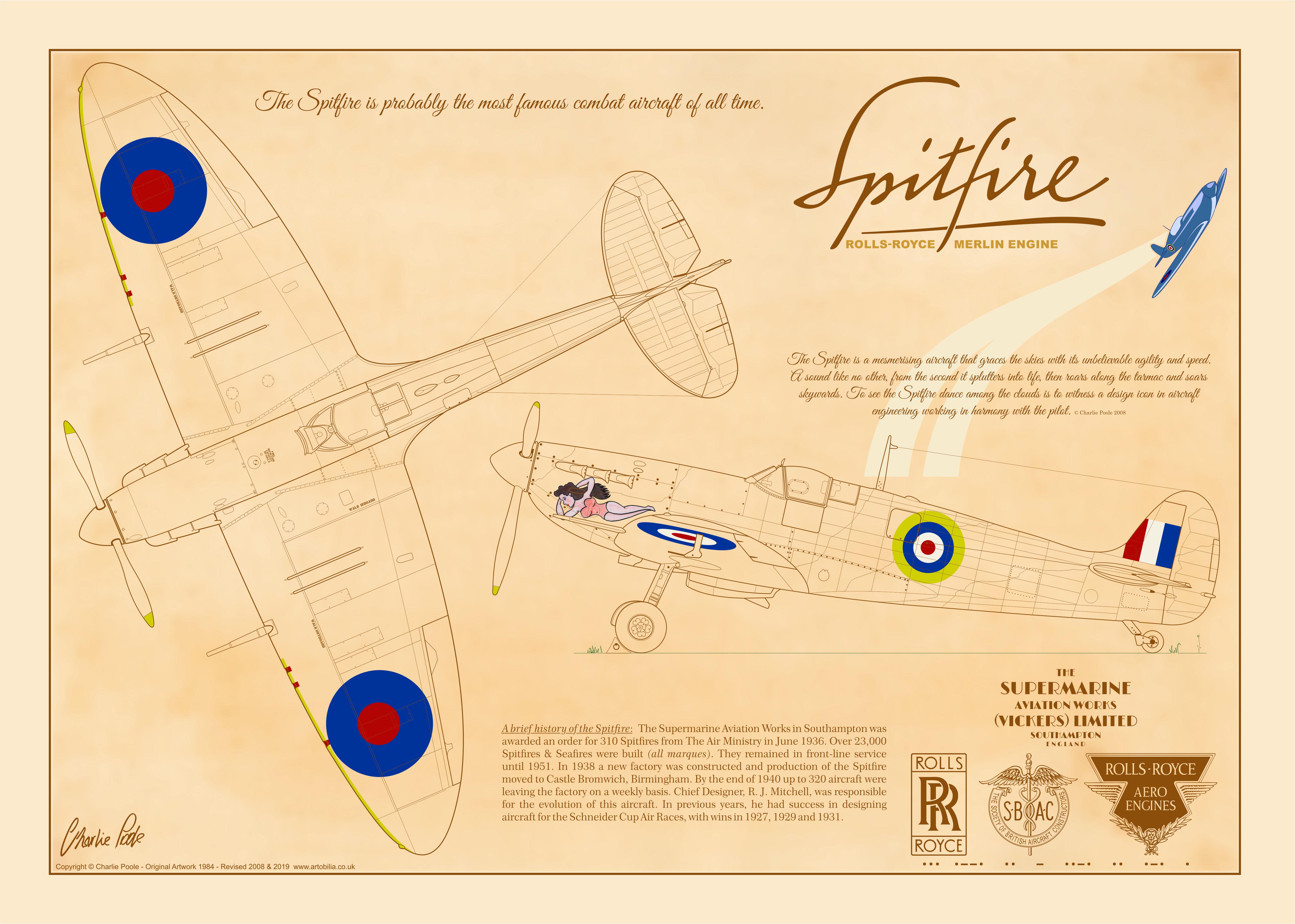
SPITFIRE - Outline on Parchment
The Supermarine Spitfire is one of the most recognisable combat aircraft ever built, and this detailed drawing grew from a fascination that began during my childhood.
My father supplied me with original aircraft photographs and reference material dating from 1938. I first drew Spitfires as pencil schoolboy doodles, then created more accurate versions when I received my first drawing board. I used those plans to build balsa-wood models, cover them with tissue paper and fly them in our local park.
Decades later, I scanned my original drawings and carefully redrew every line in Photoshop to create clean, consistent detail. The finished design combines technical specifications, historical facts, a pastel study of the aircraft’s nose and logos taken from original documents. Every logo was individually redrawn rather than copied and pasted.
The aged-paper background was made using the traditional technique of applying tea to wet paper and leaving it to dry. Sharp-eyed viewers may also discover the word “Spitfire” written in Morse code at the bottom right of the picture.
- Battle over the White Cliffs – Spitfire and Messerschmitt
- The Last Flight of G-BJHS – Short Sunderland S.25 Mk V
- Spitfire P7350 and Lancaster PA474 – RAF Coningsby, 1994
- P-51D Mustang “Big Beautiful Doll” – Little Gransden, 2019
- Crazy Horses – Two American Mustangs
- Misty Morning Return – Avro Lancaster and Lissett Memorial
- Sortie in the Peak – Lancaster “Phantom of the Ruhr”
- Hispano Buchón “White 9” – Little Gransden, 2019
- The Race – Legends of Land and Air
- RAF Spilsby, January 1944 – Lancaster ED413 and Bentley PK 9450
- The Spirit of Great Britain – Vulcan XA892 at Farnborough, 1956
- Avro Lancaster R5689 VN-N – Original Scale Drawing
- SPITFIRE - Outline on Parchment
bottom of page