top of page
Motoring Art
A collection of original motoring artwork and photography celebrating classic, historic and distinctive cars. From detailed illustration and watercolour to original photography, the collection reflects a lifelong interest in automotive design, engineering and motoring heritage.
Project type
Illustration & Photography

01
Motoring Art

01
1966 Triumph TR4A IRS
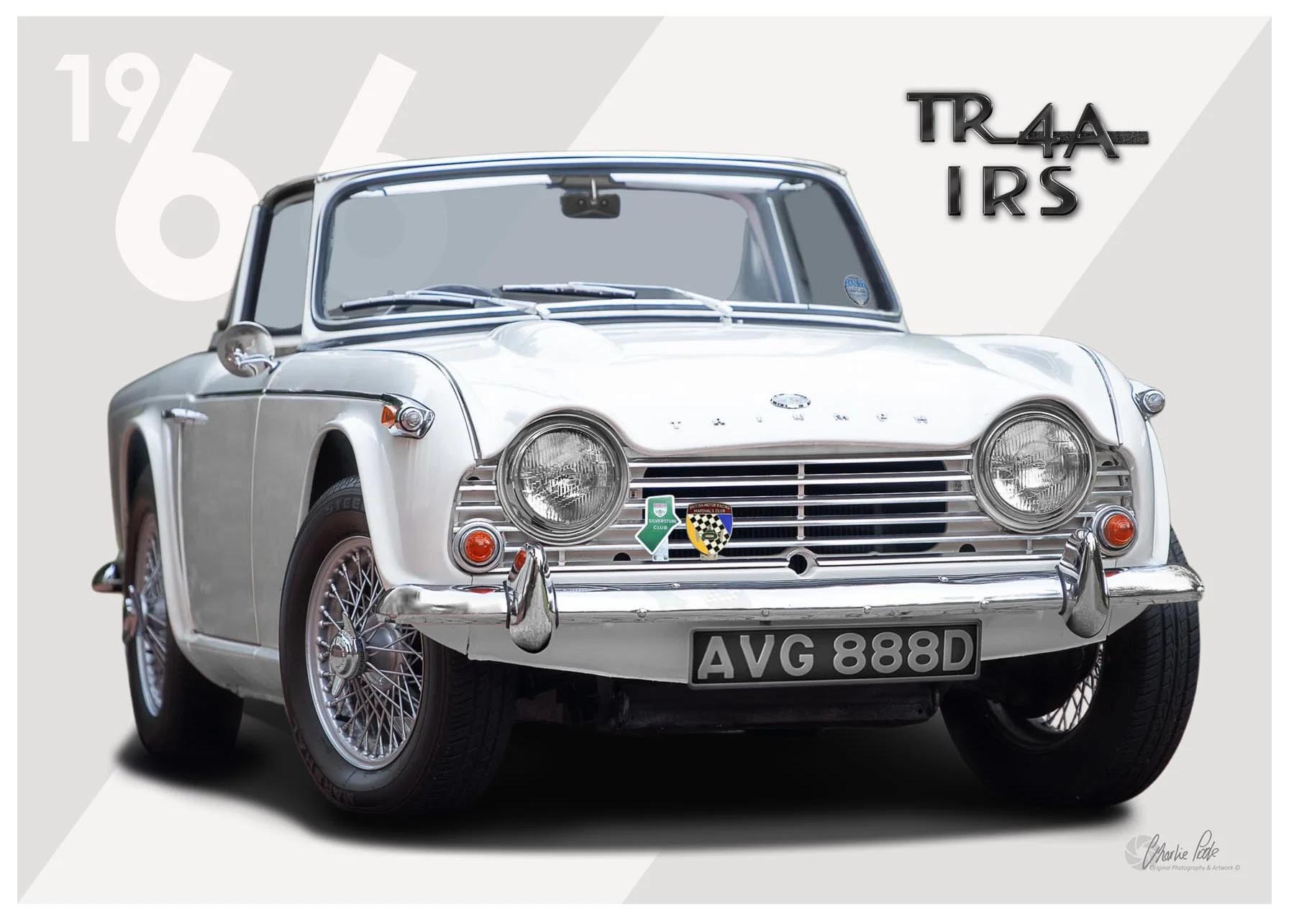
This Norwich-registered 1966 Triumph TR4A IRS was photographed by me in Norwich during the summer of 2012. The TR4A was the final development of the TR4 range, with this version featuring independent rear suspension—hence the IRS designation—together with wire wheels, overdrive and an improved folding soft top.
For this artwork, I carefully removed the original background in Photoshop and completely redrew the Triumph badge. The finished image is based entirely on my own original photograph and digital artwork.
For this artwork, I carefully removed the original background in Photoshop and completely redrew the Triumph badge. The finished image is based entirely on my own original photograph and digital artwork.

02
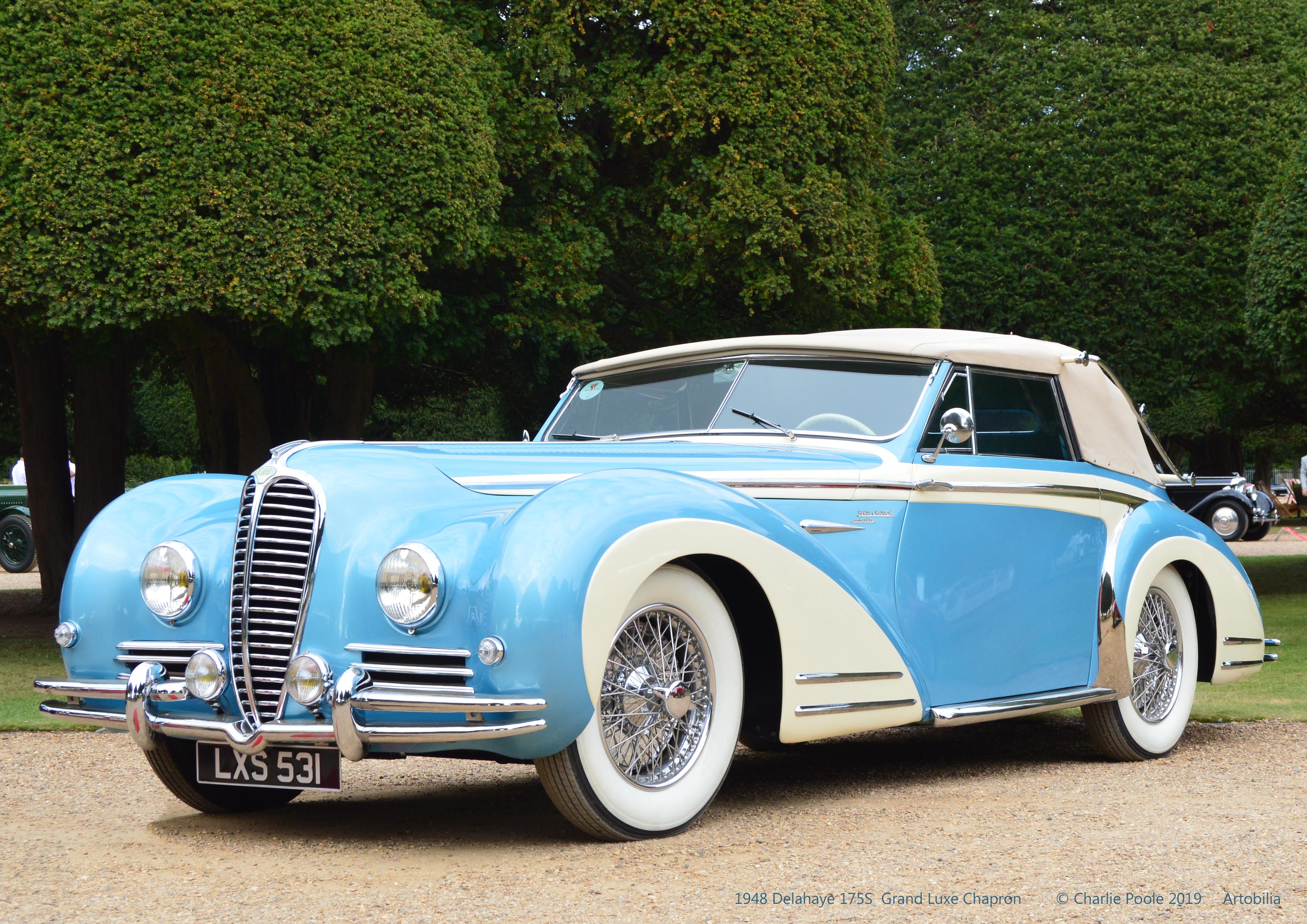
1948 Delahaye 175 S Grand Luxe by Henri Chapron
I photographed this magnificent 1948 Delahaye 175 S Grand Luxe in the grounds of Hampton Court Palace during the Concours of Elegance in September 2019. Its elegant four-seat cabriolet body was created by celebrated French coachbuilder Henri Chapron.
The Delahaye is powered by a 4,455cc overhead-valve straight-six engine and uses a Cotal four-speed electromagnetic pre-selector gearbox. Its sweeping coachwork and luxurious proportions make it a wonderful example of post-war French automotive design.
The Delahaye is powered by a 4,455cc overhead-valve straight-six engine and uses a Cotal four-speed electromagnetic pre-selector gearbox. Its sweeping coachwork and luxurious proportions make it a wonderful example of post-war French automotive design.

03
Mini 1275 GT – British Motor Museum Gaydon
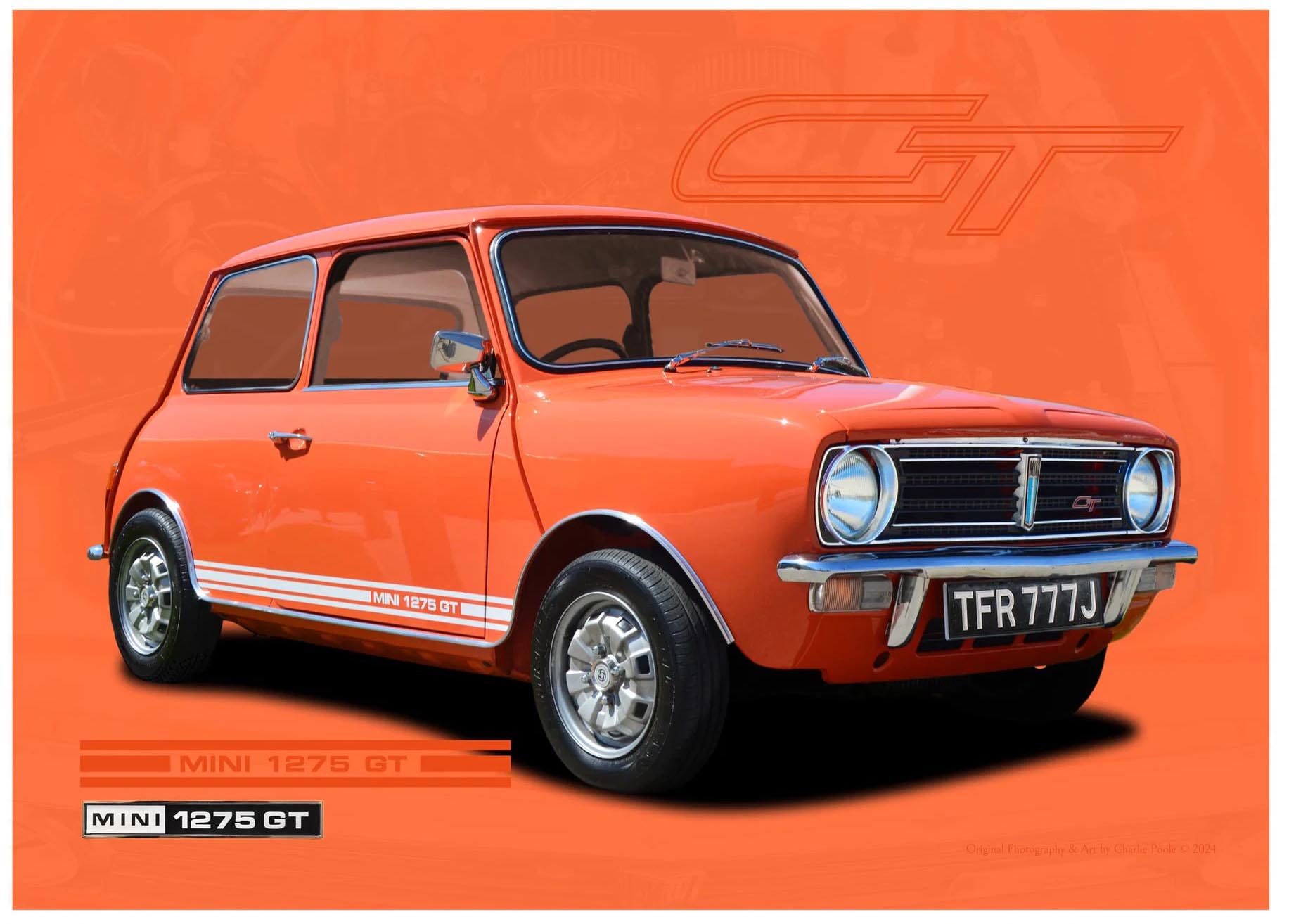
I photographed this Mini 1275 GT at the British Motor Museum in Gaydon, Warwickshire. For the finished artwork, I carefully cut out the car in Photoshop, created the shadow image of its engine bay in the background and added my own recreated badges and graphic details. The finished piece is based entirely on my original photography and artwork.
Introduced in 1969, the Mini 1275 GT was the sporting model in British Leyland’s restyled Mini range. Its distinctive extended front was designed by former Ford stylist Roy Haynes, while its 1,275cc four-cylinder engine produced approximately 60 bhp. More than 110,000 examples were built before production ended in 1980.
Introduced in 1969, the Mini 1275 GT was the sporting model in British Leyland’s restyled Mini range. Its distinctive extended front was designed by former Ford stylist Roy Haynes, while its 1,275cc four-cylinder engine produced approximately 60 bhp. More than 110,000 examples were built before production ended in 1980.

04
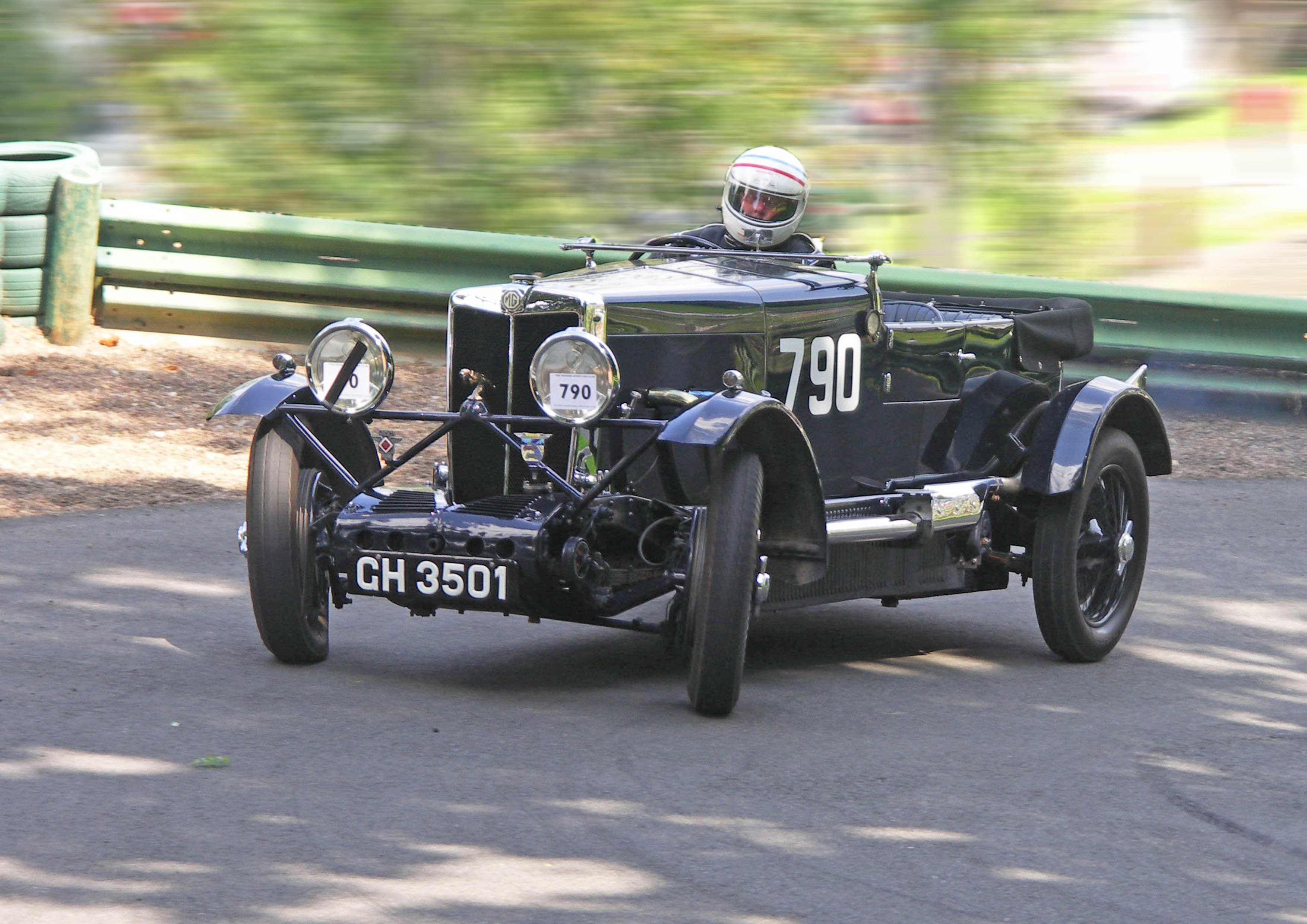
1930 MG 18/100 Mk III Tigress at Prescott
I photographed this exceptionally rare 1930 MG 18/100 Mk III Tigress during a Vintage Sports-Car Club hill climb at Prescott. Taken with my Leica, the photograph freezes the car beautifully during its timed run—even capturing the remarkable strain and distortion in the front tyre as it corners at speed.
The 2,468cc Tigress was the road-racing development of MG’s 18/80 and featured a six-cylinder engine with dry-sump lubrication. Only five examples were built, and just two are known to survive. Remarkably, both surviving cars continue to be used on the road and in competition.
The 2,468cc Tigress was the road-racing development of MG’s 18/80 and featured a six-cylinder engine with dry-sump lubrication. Only five examples were built, and just two are known to survive. Remarkably, both surviving cars continue to be used on the road and in competition.

05
MG Metro 6R4 Replica – British Motor Museum
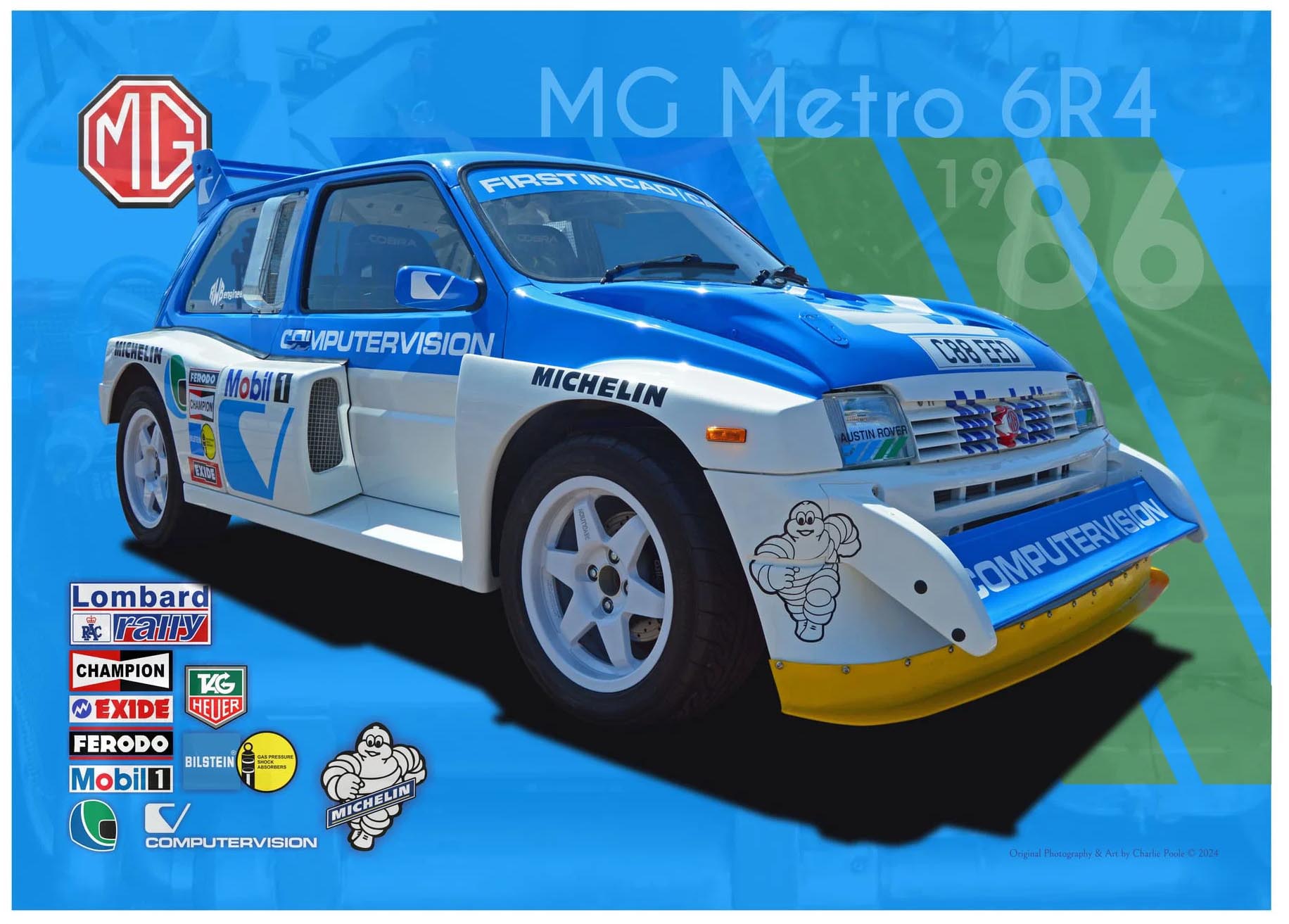
I photographed this striking replica of the legendary MG Metro 6R4 at the British Motor Museum in Gaydon, Warwickshire, on 2 June 2024. For the finished artwork, I recreated the badges, sponsor logos and graphic details by hand; none were simply copied and pasted. The piece is based entirely on my own photography and artwork.
The original Metro 6R4 was a purpose-built, mid-engined, four-wheel-drive rally car created for the spectacular Group B category. Developed with Williams Grand Prix Engineering, it used a naturally aspirated 3-litre V6 engine producing more than 400 bhp in competition form, together with permanent four-wheel drive and a seam-welded semi-monocoque chassis reinforced by tubular structures.
The original Metro 6R4 was a purpose-built, mid-engined, four-wheel-drive rally car created for the spectacular Group B category. Developed with Williams Grand Prix Engineering, it used a naturally aspirated 3-litre V6 engine producing more than 400 bhp in competition form, together with permanent four-wheel drive and a seam-welded semi-monocoque chassis reinforced by tubular structures.

06
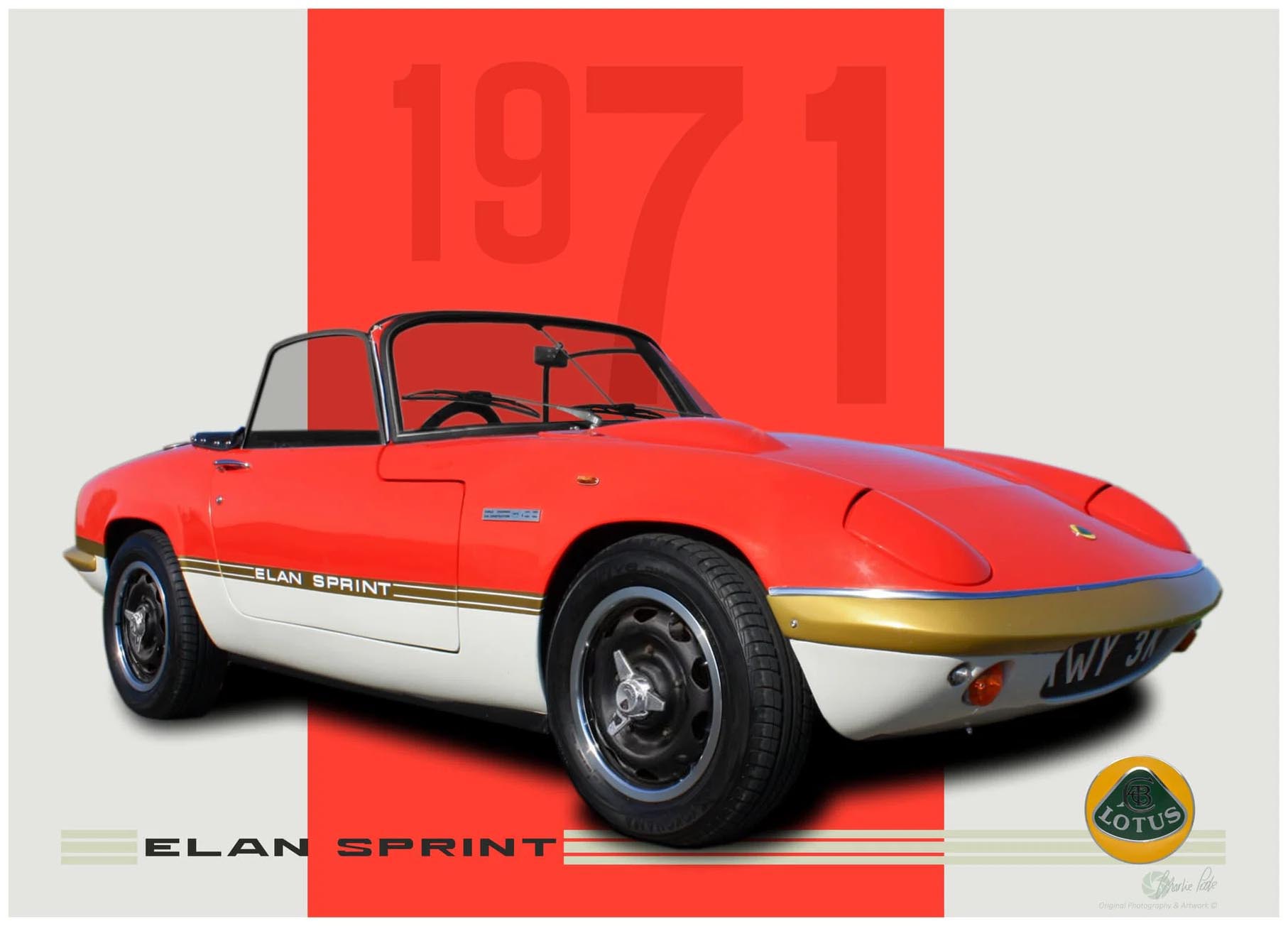
1971 Lotus Elan Sprint DHC
I photographed this 1971 Lotus Elan Sprint in July 1987, shortly after purchasing it from Paul Matty Sports Cars in Lickey End, Bromsgrove. It remains one of the finest and most enjoyable sports cars I have ever owned.
The Sprint was the ultimate development of the original Lotus Elan. Weighing approximately 700kg, its 1,558cc “Big Valve” twin-cam engine produced around 126 bhp—giving this remarkably light Drophead Coupé performance that could embarrass many much larger sports cars.
The Sprint was the ultimate development of the original Lotus Elan. Weighing approximately 700kg, its 1,558cc “Big Valve” twin-cam engine produced around 126 bhp—giving this remarkably light Drophead Coupé performance that could embarrass many much larger sports cars.

07
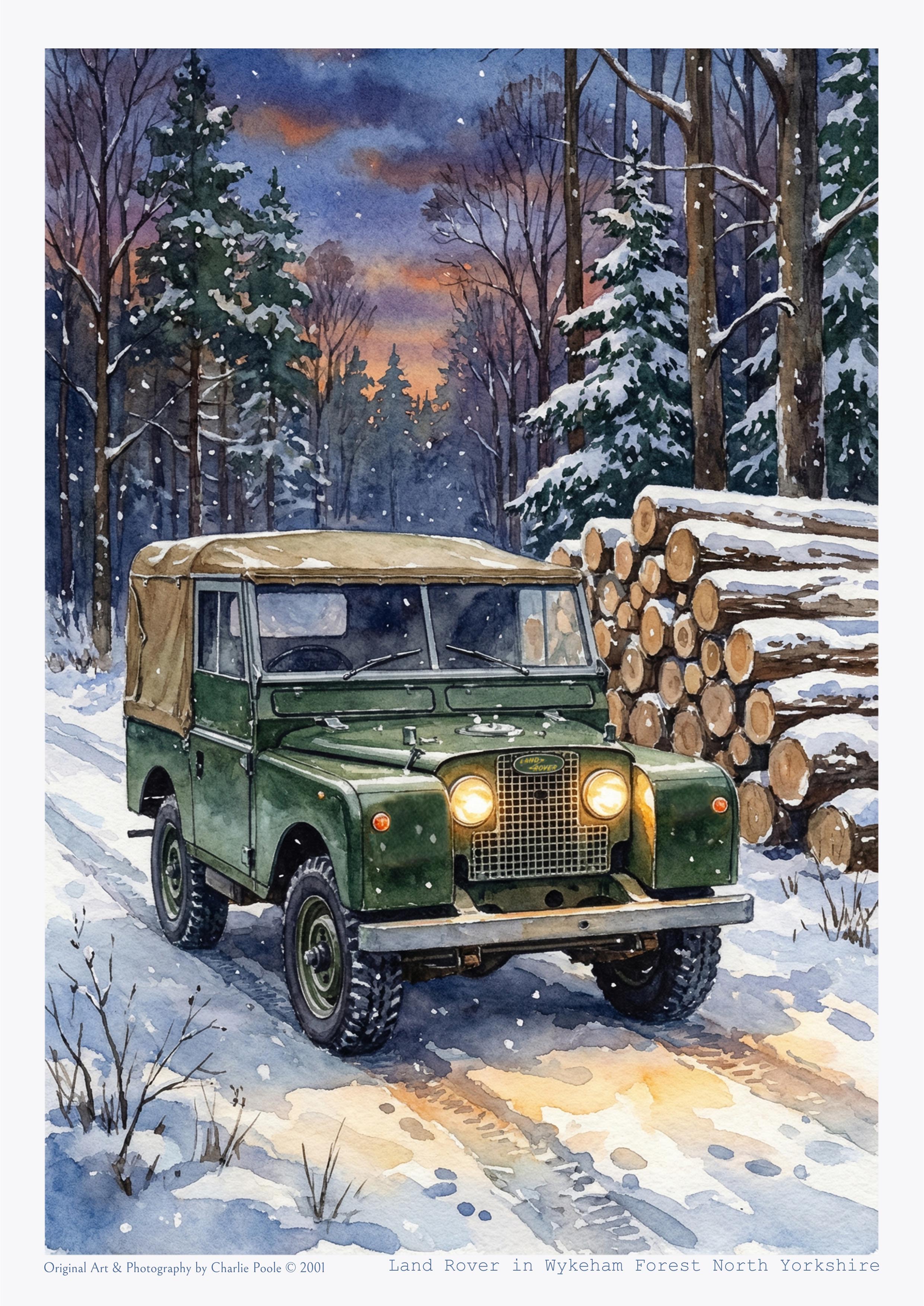
Land Rover in Wykeham Forest – 2001
I photographed this Series I Land Rover in Wykeham Forest in 2001 while my sister and I were exercising our dogs. The vehicle was used solely for forestry work and was parked on one of the forest’s many tracks.
Although the finished scene is faithful to Wykeham Forest, it is not a direct copy of a single photograph. I combined elements from three original photographs taken during the same visit, allowing me to bring additional parts of the forest into view while retaining consistent natural light and shadows. I then developed the composition into this finished watercolour artwork.
The complete method is explained in From Photograph to Watercolour Artwork & Digital Art.

08
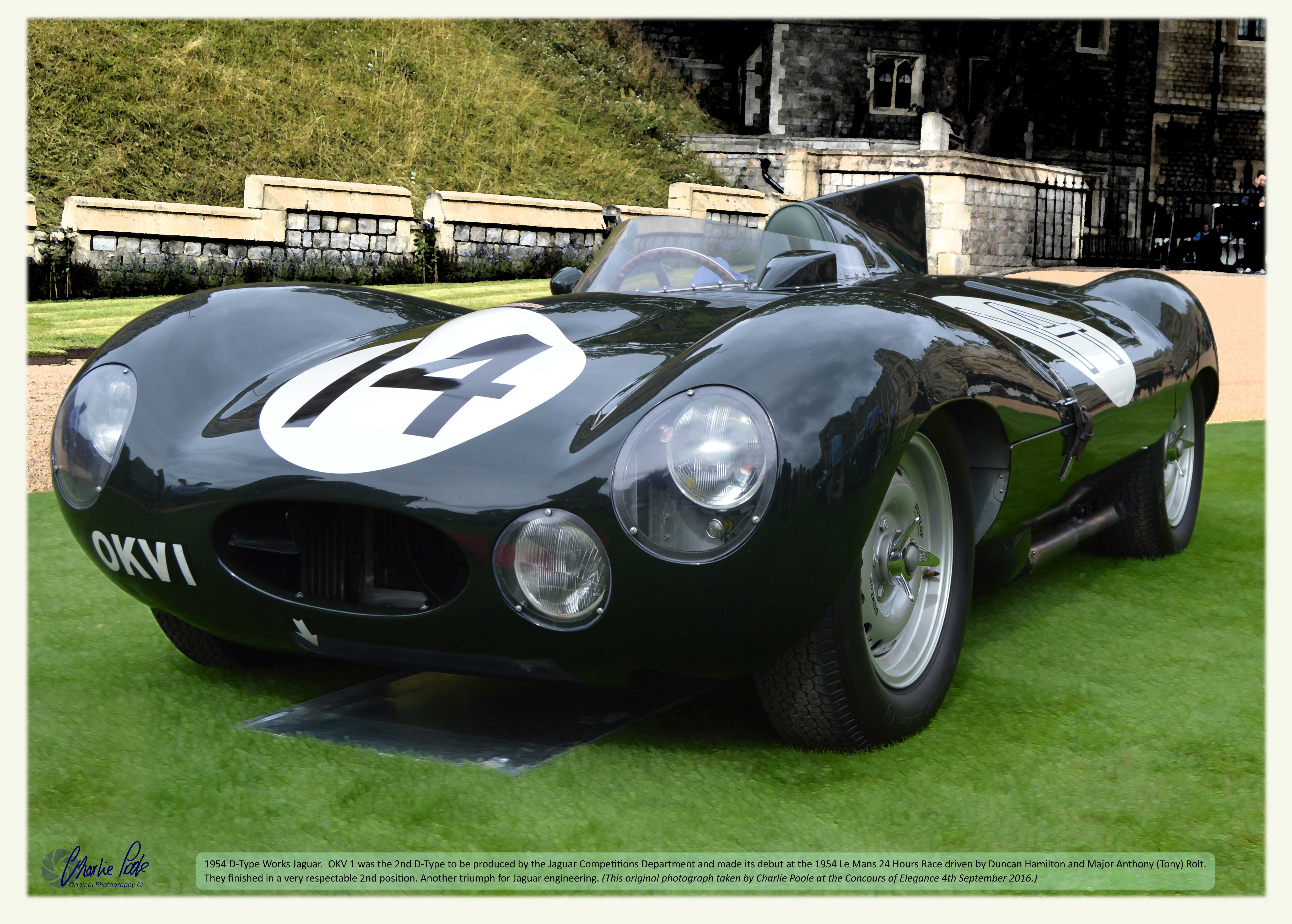
1954 Jaguar D-Type Works Car OKV 1
I photographed this historic Jaguar D-Type, registration OKV 1, at the Concours of Elegance on 4 September 2016. Finished in British Racing Green and carrying race number 14, it is one of the most important cars from Jaguar’s celebrated competition history.
OKV 1 was the second D-Type produced by Jaguar’s Competitions Department. It made its racing debut at the 1954 24 Hours of Le Mans, where Duncan Hamilton and Tony Rolt drove it to an outstanding second-place finish. Its aerodynamic bodywork, distinctive tail fin and wraparound windscreen demonstrate the advanced engineering that helped establish the D-Type as a Le Mans legend.
OKV 1 was the second D-Type produced by Jaguar’s Competitions Department. It made its racing debut at the 1954 24 Hours of Le Mans, where Duncan Hamilton and Tony Rolt drove it to an outstanding second-place finish. Its aerodynamic bodywork, distinctive tail fin and wraparound windscreen demonstrate the advanced engineering that helped establish the D-Type as a Le Mans legend.

09
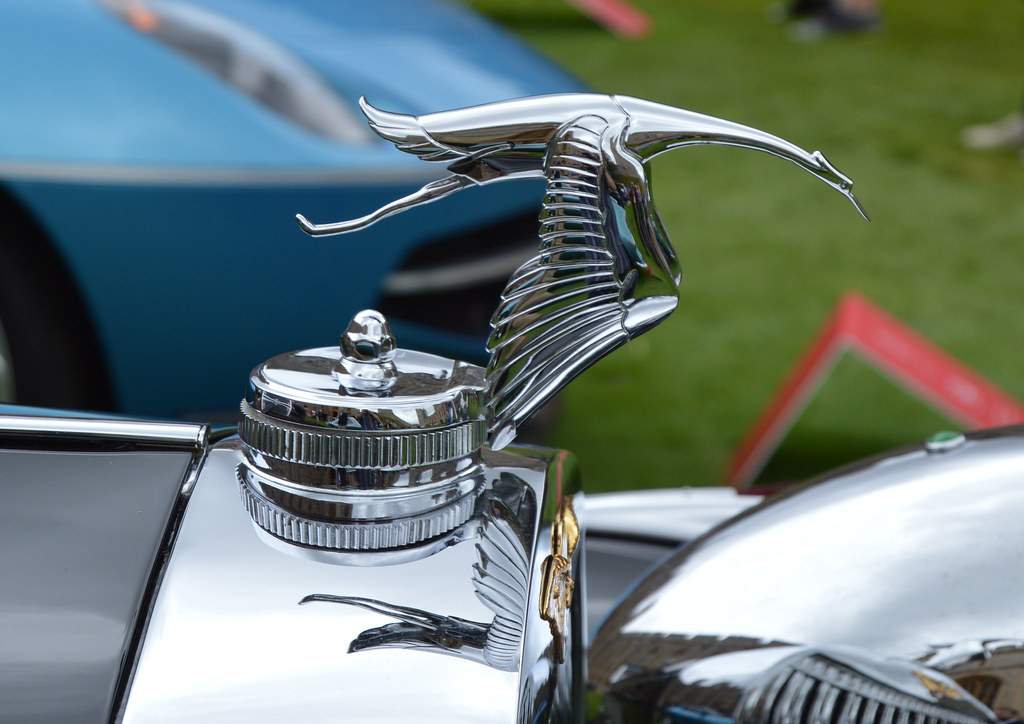
Hispano-Suiza Flying Stork – London Concours
I photographed this beautifully detailed Hispano-Suiza “Flying Stork” bonnet mascot at the London Concours in the grounds of the Honourable Artillery Company. By concentrating closely on the mascot and polished radiator cap, the photograph celebrates one of motoring history’s most elegant emblems.
Known as La Cigogne, the stork was adopted by Hispano-Suiza after the First World War. It honoured French fighter ace Georges Guynemer and his celebrated “Storks” squadron, whose aircraft were powered by Hispano-Suiza engines and carried the bird as their emblem.
Known as La Cigogne, the stork was adopted by Hispano-Suiza after the First World War. It honoured French fighter ace Georges Guynemer and his celebrated “Storks” squadron, whose aircraft were powered by Hispano-Suiza engines and carried the bird as their emblem.

10
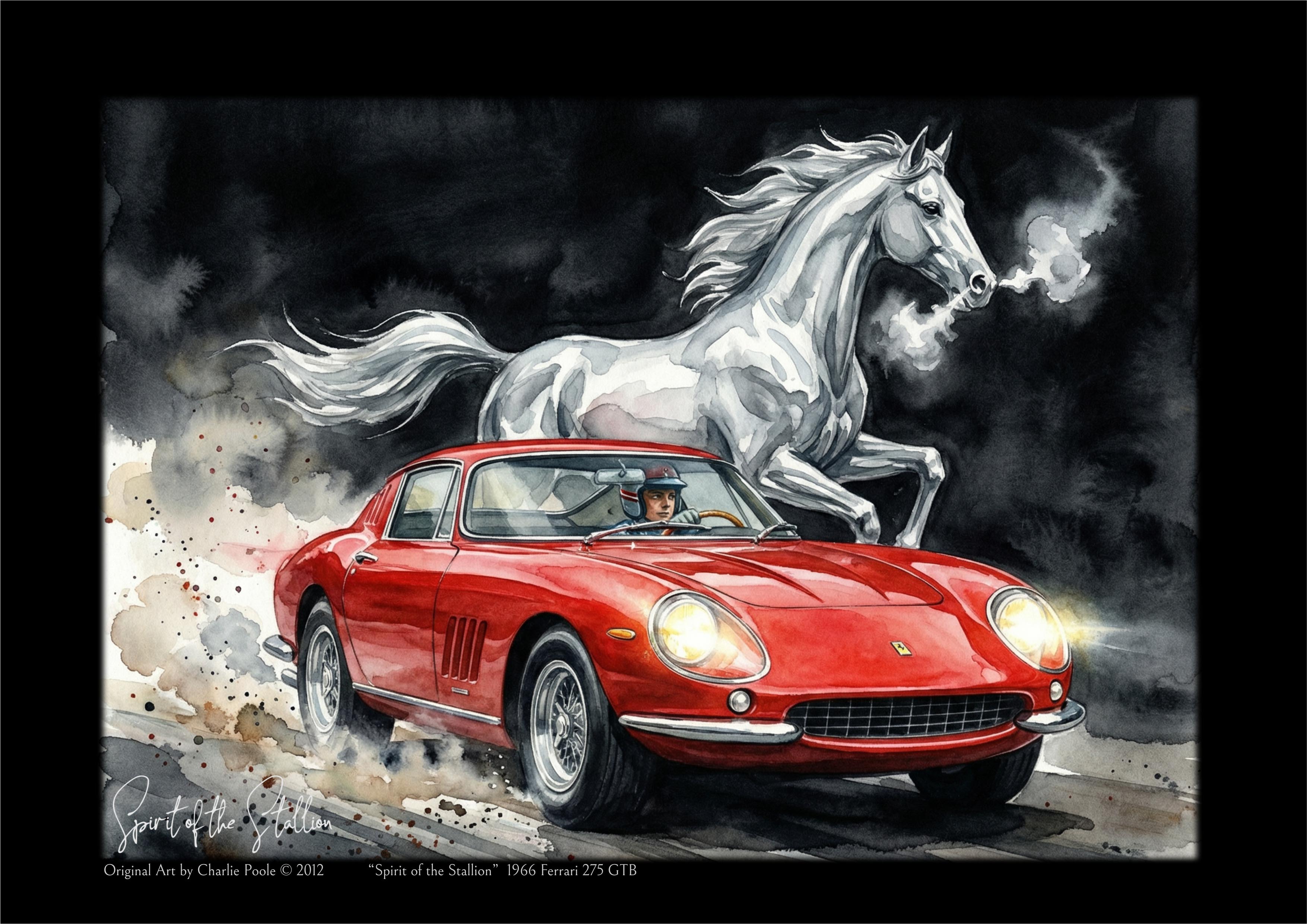
Ferrari and Silver Horse - Spirit of the Stallion – 1966 Ferrari 275 GTB/C
I created Spirit of the Stallion from several of my own photographs. The 1966 Ferrari 275 GTB/C was photographed at the Pebble Beach Concours d’Elegance in August 2011, while the five-metre stainless-steel Cavallino Rampante sculpture was photographed near the Ferrari factory in Maranello during a visit to Italy in 2006. I combined these separate elements before developing the composition through my watercolour and digital-art process.
The Ferrari is one of only twelve lightweight, Scaglietti-bodied 275 GTB/C competition cars built for the 1966 season. Delivered to Scuderia Filipinetti, it later won its class and finished 11th overall at the 1967 24 Hours of Le Mans—an exceptional competition history for an exceptionally beautiful car.
The complete method is explained in From Photograph to Watercolour Artwork & Digital Art.

11
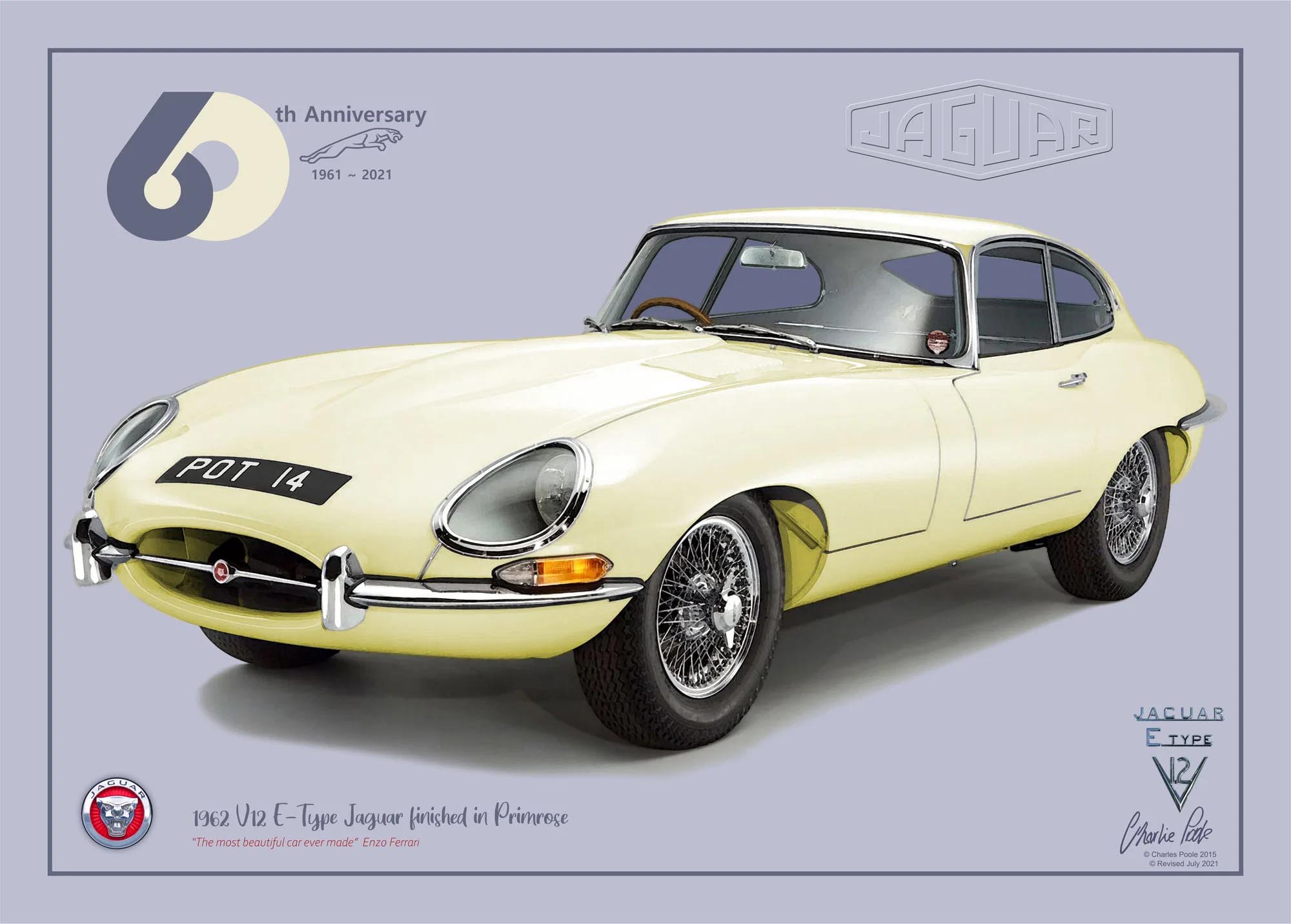
My Father’s 1962 Jaguar E-Type Series 1
This is the only surviving photograph of my father’s Primrose Yellow 1962 Jaguar E-Type Series 1. The original image was in extremely poor condition, so I rebuilt the appearance of the car in Photoshop using layers and the aerosol-painting tool—a restoration technique I had used only once before. This accounts for the deliberately subdued reflections visible in the finished image.
The car originally carried my father’s registration number, POT 114, which remains in our family and is now displayed on another vehicle. For privacy, I removed one digit from the registration shown here. I also isolated the car from its original background, restored and redrew the badges, and created the accompanying 60 Years emblem. The finished artwork is entirely based on my family photograph, my restoration work and my own graphic design.
The car originally carried my father’s registration number, POT 114, which remains in our family and is now displayed on another vehicle. For privacy, I removed one digit from the registration shown here. I also isolated the car from its original background, restored and redrew the badges, and created the accompanying 60 Years emblem. The finished artwork is entirely based on my family photograph, my restoration work and my own graphic design.

12
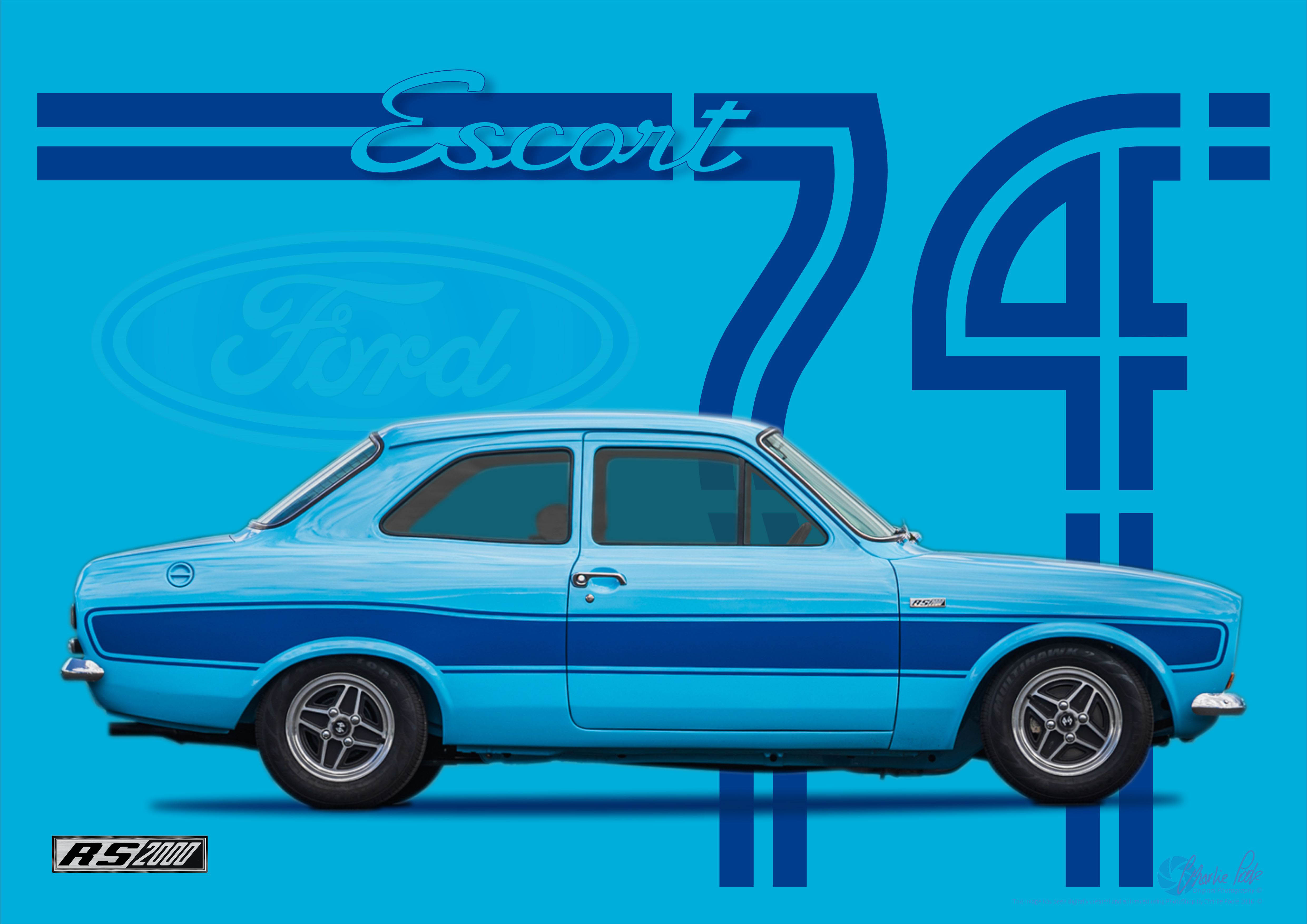
Ford Escort RS2000 Mk1 in Olympic Blue
I photographed this superb Olympic Blue Ford Escort RS2000 Mk1 at Donington Park in 2019. Starting with my original photograph, I isolated and reworked the car in Photoshop, created a new background and added period-style badges that I drew by hand rather than copying from photographs.
Introduced in 1973, the Mk1 RS2000 combined Ford’s 2.0-litre Pinto engine with a four-speed gearbox and the Escort’s lightweight, rear-wheel-drive chassis. Built by Ford’s Advanced Vehicle Operations division, it offered approximately 100 bhp and became one of the most desirable sporting Escorts of its era.
This artwork demonstrates the Photograph to Photograph and Digital Art method explained in From Photograph to Watercolour Artwork & Digital Art.

13
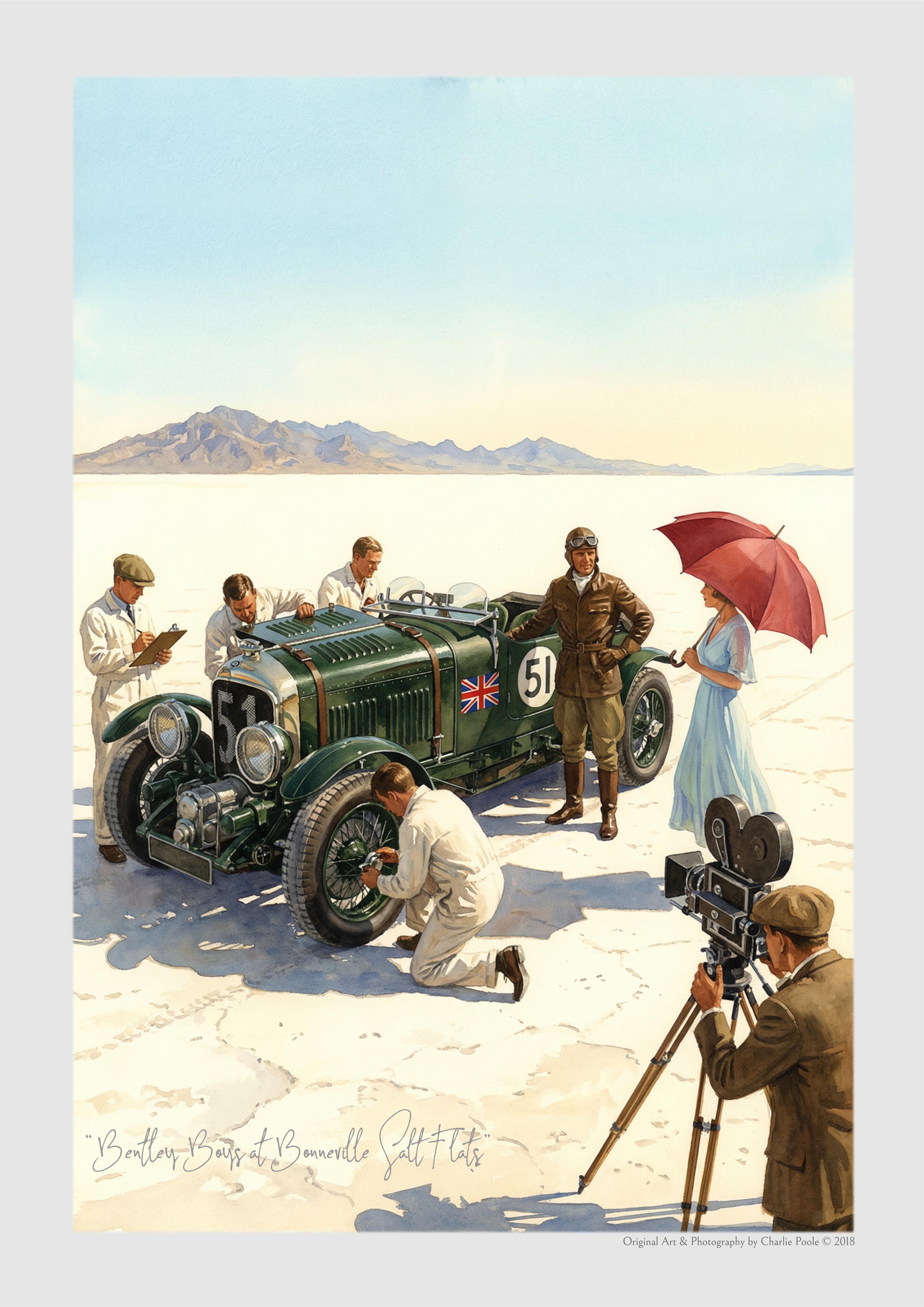
Bentley Boys at Bonneville – An Imagined 1929
This commissioned watercolour began with my photograph of a vintage Bentley at the Goodwood Festival of Speed, taken while I wobbled precariously on a pair of borrowed steps. Every person in the finished scene is a member of my family, persuaded into imaginary poses in our back garden and photographed repeatedly until the viewpoint and angle were correct.
I drew and painted each figure separately in watercolour, scanned the individual paintings and then carefully assembled the complete scene in Photoshop. I also researched the period camera shown in the picture so that this imaginary moment would remain visually convincing.
The joke is that neither this Bentley nor the famous Bentley Boys ever visited the Bonneville Salt Flats. Perhaps they should have. This is fantasy realism: a scene that never happened, constructed from original photography, traditional watercolour and digital artwork to look as though it might have.
14
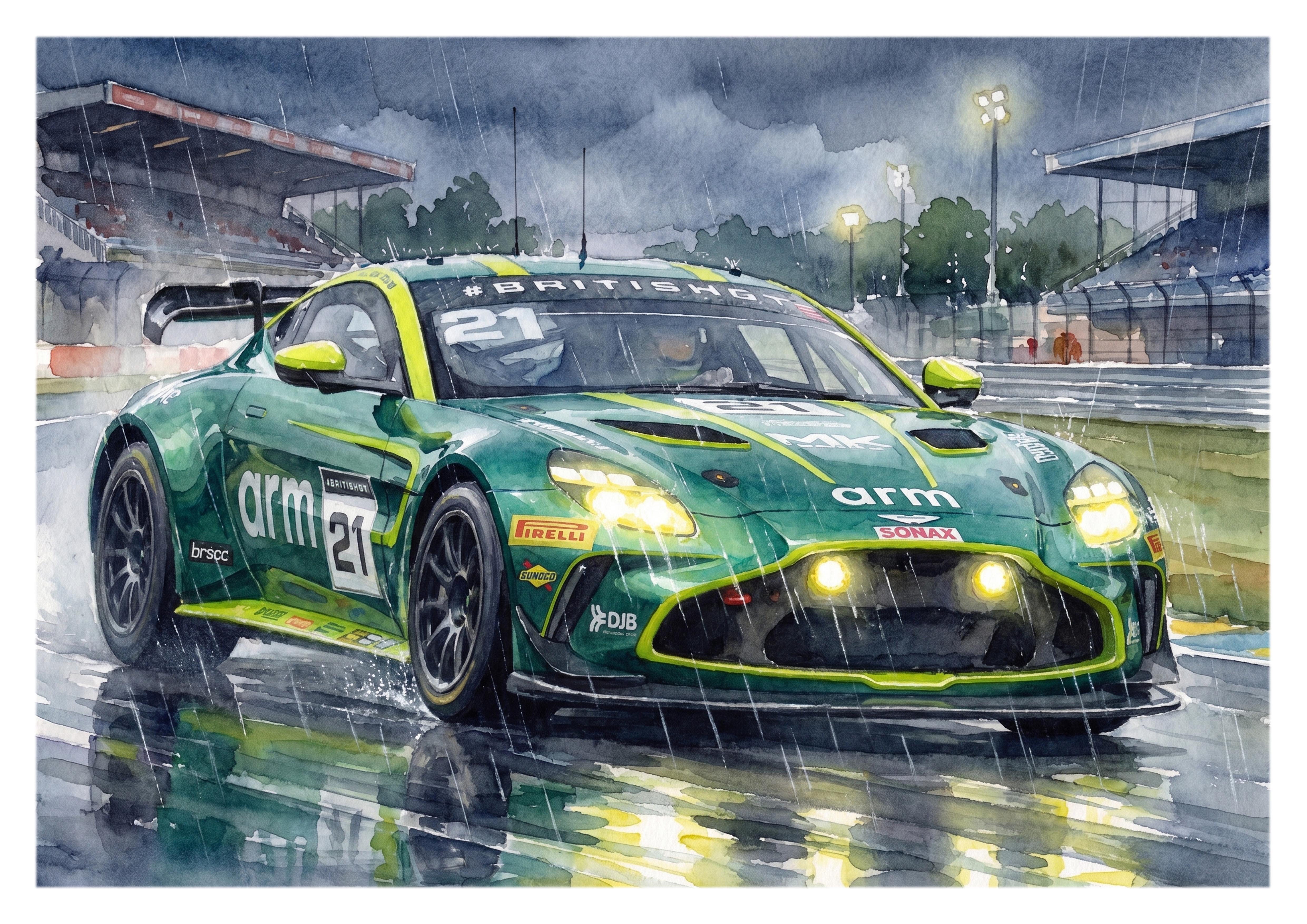
Le Mans in the Rain – An AI-Assisted Experiment
This image began as my own photograph, taken in daylight at the Le Mans 24 Hours. I felt that the original lacked atmosphere, so I first transformed it into a watercolour-style image, but I was still dissatisfied with the result.
As an experiment, I then asked an AI image tool to reinterpret my artwork as a night-time race in pouring rain. The dramatic lighting, rain and nocturnal atmosphere were generated during that stage. The original car photograph and initial preparation are mine, but the finished scene is openly presented as an AI-assisted transformation rather than a wholly traditional Charlie Poole artwork.
As an experiment, I then asked an AI image tool to reinterpret my artwork as a night-time race in pouring rain. The dramatic lighting, rain and nocturnal atmosphere were generated during that stage. The original car photograph and initial preparation are mine, but the finished scene is openly presented as an AI-assisted transformation rather than a wholly traditional Charlie Poole artwork.
15
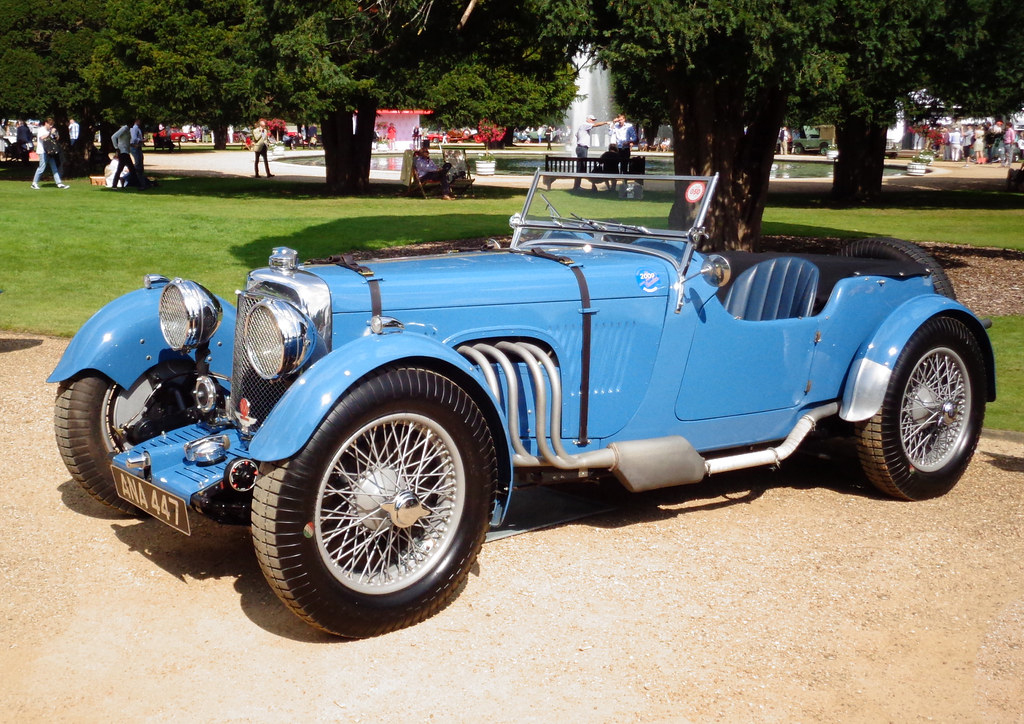
1933 Aston Martin 1½-Litre Le Mans – ANA 447
I photographed this 1933 Aston Martin 1½-Litre Le Mans, registration ANA 447, at the Concours of Elegance at Hampton Court Palace in 2019.
The Le Mans model is one of the most significant pre-war Aston Martins and helped establish the marque’s reputation for beautifully engineered, high-performance sports cars. Sir Malcolm Campbell once owned another example of this model, finished appropriately in his famous Blue Bird Blue—although sadly not the car shown here.
This is straightforward, traditional photography: no watercolour, no artificial intelligence and no Photoshop reconstruction—just the car, the light and a plain old camera.

16
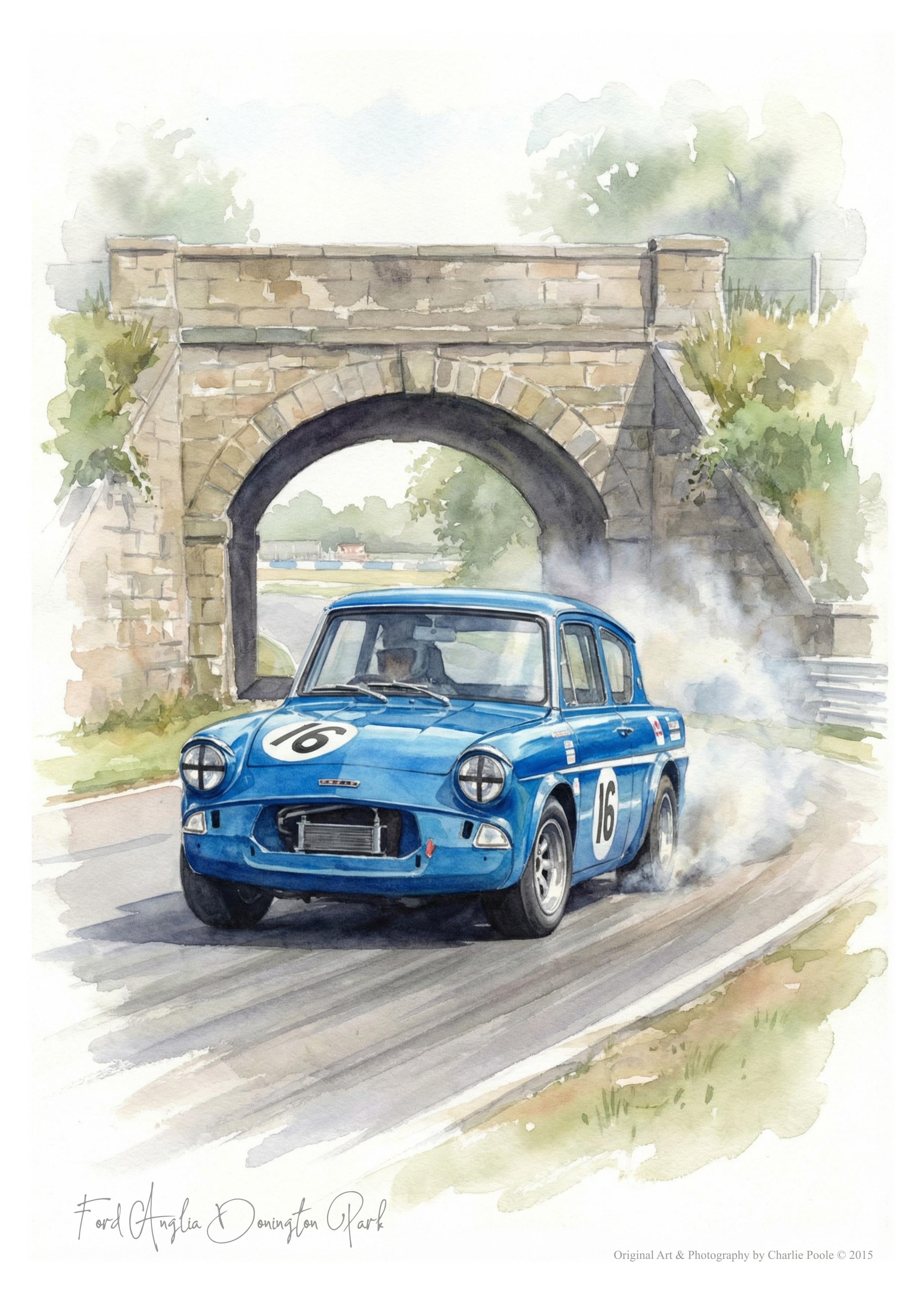
Anglia at Starkey’s Bridge – A Race That Never Happened
I photographed this Ford Anglia 105E at a classic race meeting at Brands Hatch, probably in 2014. Despite its modest appearance, the car had somehow acquired a Ford 2-litre Pinto engine, twin side-draught Weber carburettors and a strut brace across the engine bay. For my finished artwork, I changed its racing number to 16.
Everything beyond the original car is fiction. I placed it racing beneath Starkey’s Bridge at Donington Park, using my own photograph of the bridge taken in 1984. Tom Wheatcroft purchased the derelict circuit in 1971, but racing did not return until 1977. By then, the rebuilt course bypassed the bridge’s narrow arches, so this Anglia could never have raced through them.
The result is another piece of fantasy realism: separate photographs, traditional watercolour and digital assembly used to create a convincing event that never happened. The method is explained in From Photograph to Watercolour Artwork & Digital Art.
17
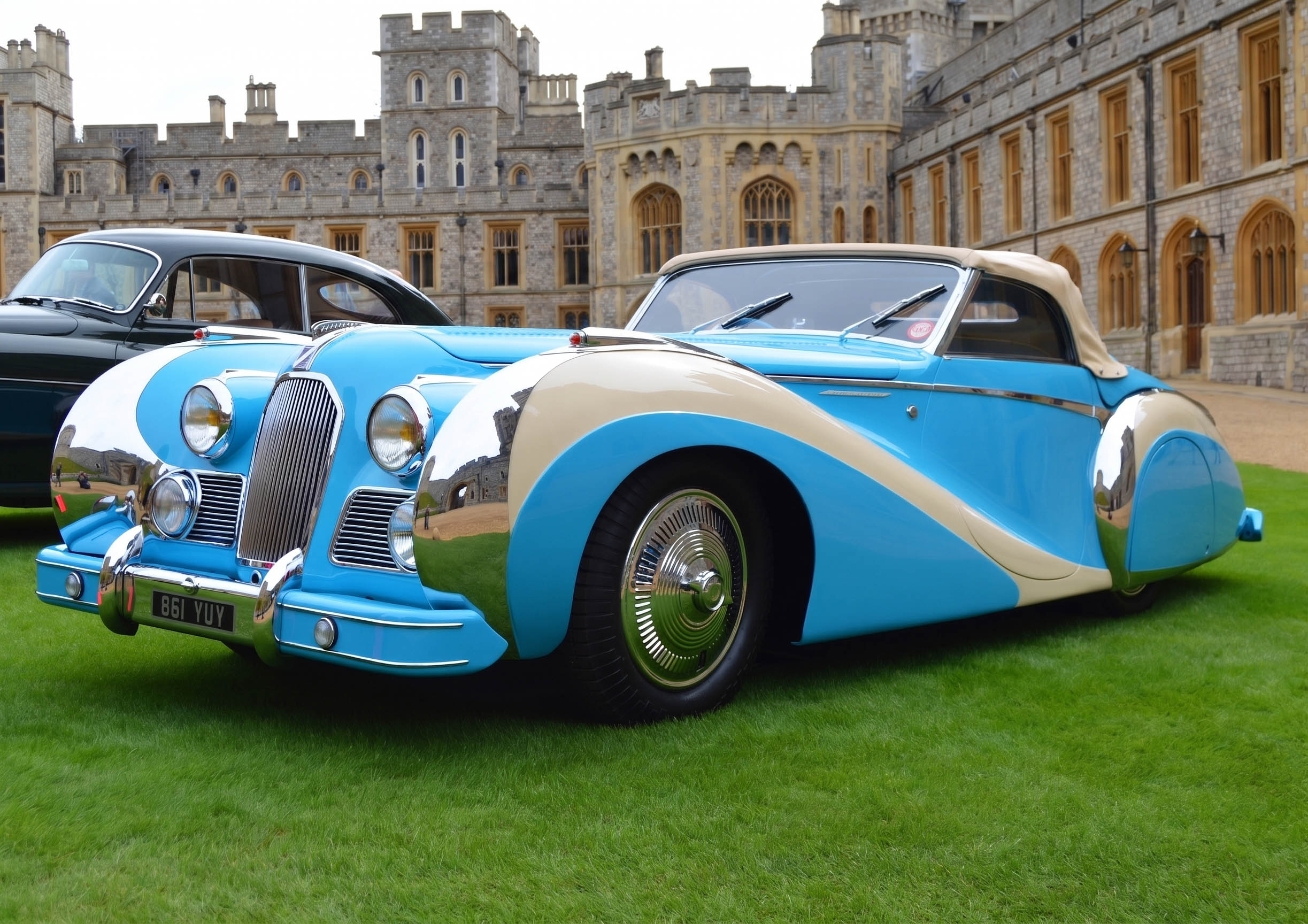
1948 Talbot-Lago T26 Grand Sport Cabriolet
I photographed this extraordinary 1948 Talbot-Lago T26 Grand Sport Cabriolet at the Concours of Elegance at Hampton Court Palace in 2019. This is traditional, unaltered photography—the remarkable blue-and-cream coachwork and sweeping chrome ornamentation really are as dramatic as they appear.
Its rare short-wheelbase Grand Sport chassis carries a 4,482cc twin-cam, six-cylinder engine producing approximately 190 bhp. Only 29 short-wheelbase chassis were made. The flamboyant cabriolet body is a painstaking modern recreation of the car’s original—and now lost—coachwork, created in the unmistakable style of Parisian coachbuilder Jacques Saoutchik.
Its rare short-wheelbase Grand Sport chassis carries a 4,482cc twin-cam, six-cylinder engine producing approximately 190 bhp. Only 29 short-wheelbase chassis were made. The flamboyant cabriolet body is a painstaking modern recreation of the car’s original—and now lost—coachwork, created in the unmistakable style of Parisian coachbuilder Jacques Saoutchik.

18
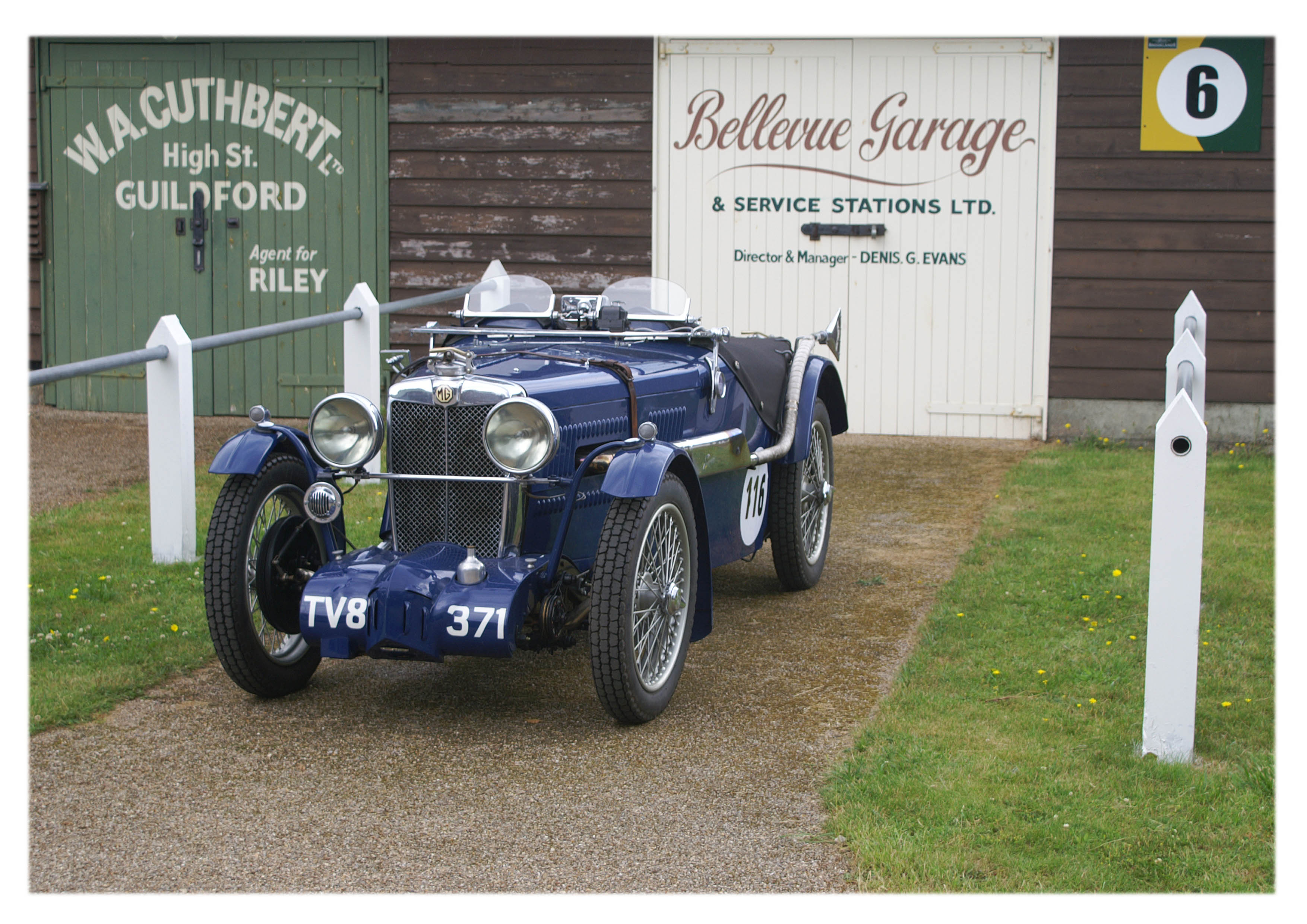
1933 MG J4 Midget at Brooklands – TV 8371
I photographed this exceptionally rare 1933 MG J4 Midget at Brooklands using my Leica. The car is registration TV 8371, chassis J4005, and was originally built for racing driver Luis Fontès.
Only nine J4 Midgets were produced by the MG factory. These lightweight, supercharged racing cars became renowned as pre-war “giant killers,” capable of challenging considerably larger machinery.
The historic W. A. Cuthbert and Bellevue Garage signs behind the car are genuine Brooklands paddock features situated beside the Campbell Sheds. There is no digital reconstruction here—this is the car exactly as I photographed it.

19
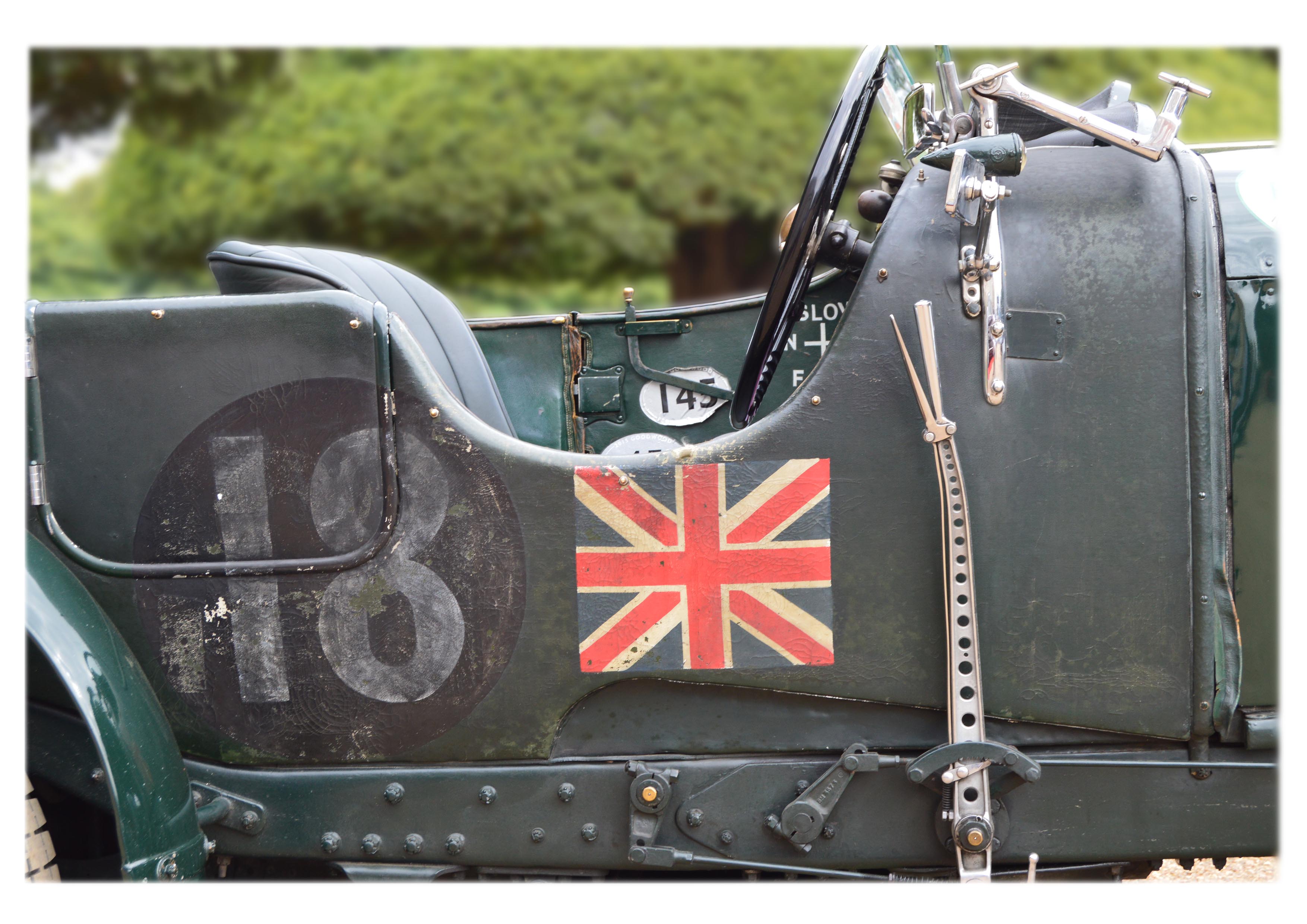
Bentley 4½-Litre Blower Team Car – Hampton Court
I photographed this historic Bentley 4½-Litre Blower Team Car at the Concours of Elegance at Hampton Court Palace in 2019. This is an unaltered photograph, concentrating on the wonderfully purposeful detail and character of the car.
The supercharged “Blower” Bentley was developed through the determination of Sir Henry “Tim” Birkin, one of the celebrated Bentley Boys. Its prominent supercharger, mounted ahead of the radiator, helped make it one of the most recognisable competition cars of the pre-war era. Although this example clearly belongs to that remarkable history, I cannot confirm which Bentley Boy may once have owned it.
The supercharged “Blower” Bentley was developed through the determination of Sir Henry “Tim” Birkin, one of the celebrated Bentley Boys. Its prominent supercharger, mounted ahead of the radiator, helped make it one of the most recognisable competition cars of the pre-war era. Although this example clearly belongs to that remarkable history, I cannot confirm which Bentley Boy may once have owned it.

20
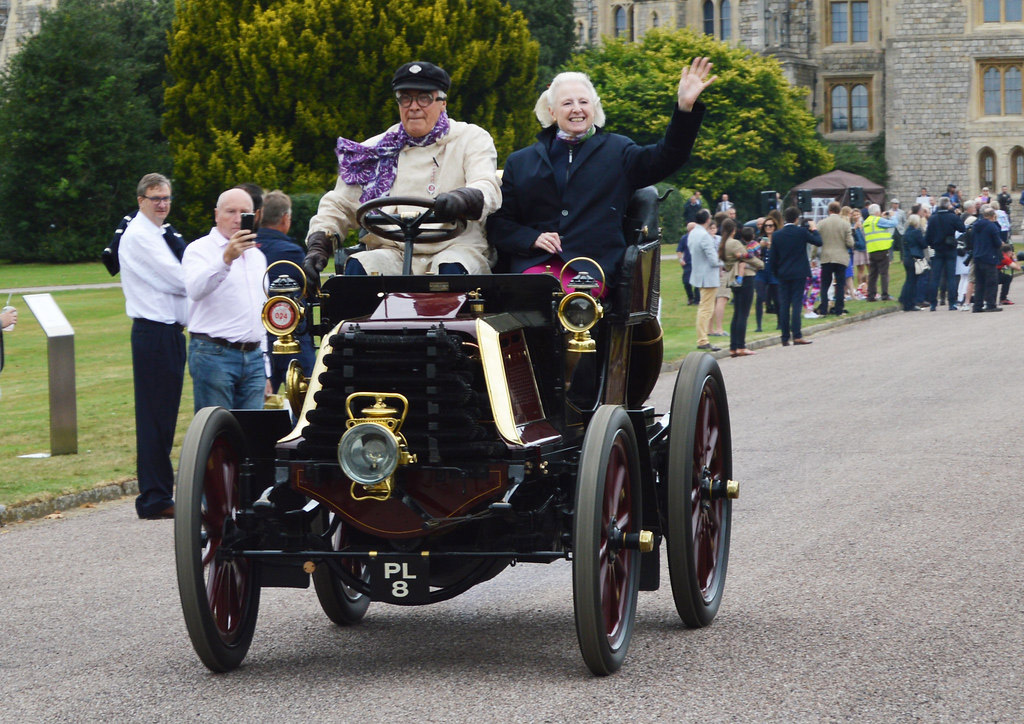
1901 Panhard et Levassor – Hampton Court Concours
I photographed this remarkable 1901 Panhard et Levassor with my Leica as it departed the Concours of Elegance at Hampton Court Palace. Although the precise date has escaped me, comparison with event records suggests that it was most probably taken in September 2019.
Panhard et Levassor was one of the pioneering names of the early motor industry. The company helped establish the familiar arrangement of a front-mounted engine driving the rear wheels through a geared transmission—an influential layout once known as the Système Panhard.
This is an original, unaltered photograph by Charlie Poole ©, capturing the car and its passengers taking part in the wonderful departure procession from Hampton Court.

21
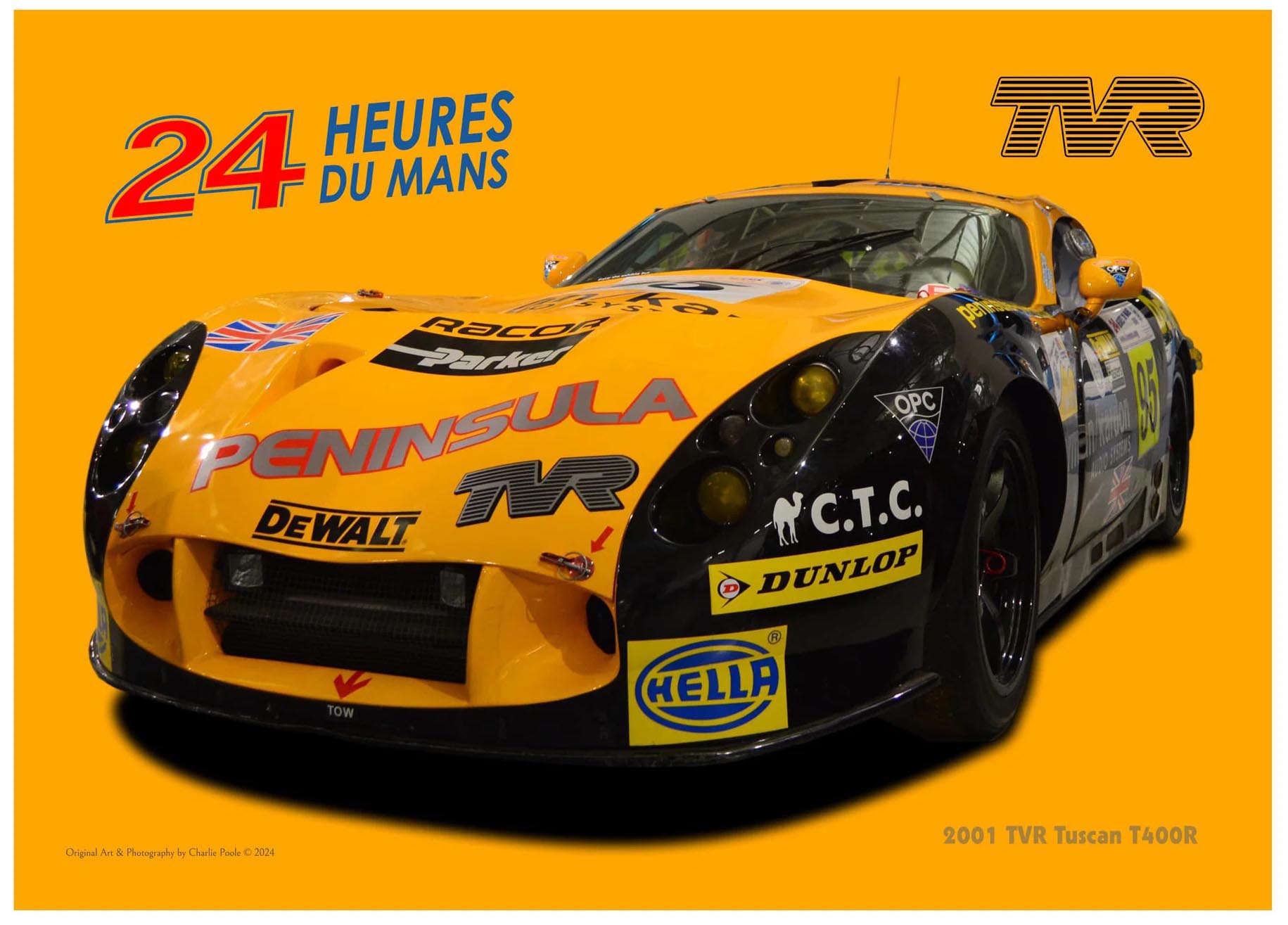
TVR Tuscan T400R Le Mans Race Car – 2001 by Charlie Poole
The TVR Tuscan T400R was developed to return TVR to international GT racing. Powered by a naturally aspirated 4.0-litre TVR Speed Six engine producing approximately 400 bhp, it made its competitive debut in the British GT Championship in 2001. The T400R subsequently took TVR back to the 24 Hours of Le Mans in 2003.
I photographed this remarkable race car at the British Motor Museum in Gaydon, Warwickshire. After carefully removing the original background in Photoshop, I created the vivid presentation and redrew the 24 Heures du Mans and TVR logos by hand. No AI was used in the creation of this artwork.
Original photography and artwork by Charlie Poole ©
- 1966 Triumph TR4A IRS
- 1948 Delahaye 175 S Grand Luxe by Henri Chapron
- Mini 1275 GT – British Motor Museum Gaydon
- 1930 MG 18/100 Mk III Tigress at Prescott
- MG Metro 6R4 Replica – British Motor Museum
- 1971 Lotus Elan Sprint DHC
- Land Rover in Wykeham Forest – 2001
- 1954 Jaguar D-Type Works Car OKV 1
- Hispano-Suiza Flying Stork – London Concours
- Ferrari and Silver Horse - Spirit of the Stallion – 1966 Ferrari 275 GTB/C
- My Father’s 1962 Jaguar E-Type Series 1
- Ford Escort RS2000 Mk1 in Olympic Blue
- Bentley Boys at Bonneville – An Imagined 1929
- Le Mans in the Rain – An AI-Assisted Experiment
- 1933 Aston Martin 1½-Litre Le Mans – ANA 447
- Anglia at Starkey’s Bridge – A Race That Never Happened
- 1948 Talbot-Lago T26 Grand Sport Cabriolet
- 1933 MG J4 Midget at Brooklands – TV 8371
- Bentley 4½-Litre Blower Team Car – Hampton Court
- 1901 Panhard et Levassor – Hampton Court Concours
- TVR Tuscan T400R Le Mans Race Car – 2001 by Charlie Poole
bottom of page